Answer Engine Optimization: How to Be the Source AI Quotes
Ranking puts you in a list. Being quoted puts you in the answer. The second is a different job, and most sites are not doing it.
What answer engine optimization means
Answer engine optimization, usually shortened to AEO, is the work of making your pages the source an AI system quotes when it answers a question. The answer engines in question are ChatGPT, Perplexity, Google's AI Overviews, Copilot and whatever follows them.
The distinction from classic SEO is not marketing. In search you compete for a position in a list, and positions two through ten still receive traffic. In an answer you compete to be cited, and there is no second place. Either your page is one of the handful the system quotes, or it does not appear at all.
Why a new term was needed
Reasonable people argue AEO is just SEO done well, and there is something to that. Nearly everything that earns a citation also helps rankings. But three differences are real enough to change what you do.
The unit is a passage
Search engines rank pages. Answer engines quote passages. A page can be excellent overall and still contain no section that survives being lifted out of context, which makes it unrankable in the new sense while ranking perfectly well in the old one.
Authority matters less than precision
Ranking rewards accumulated domain authority, which is why new sites wait. Citation rewards being the clearest answer to a specific question, which a new site can achieve immediately on a question nobody has answered well.
The result is winner-take-most
An answer cites two or three sources. Being fourth best earns nothing, where being fourth in search results still earns clicks.
How answer engines choose sources
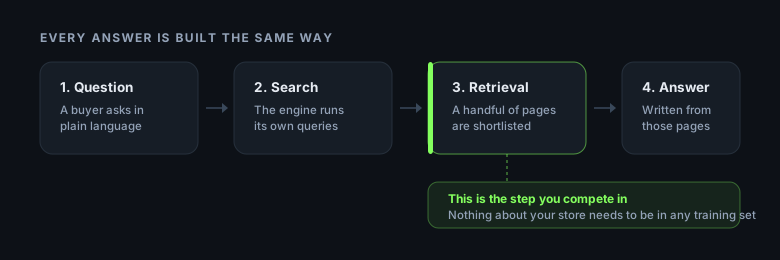
Broadly the same pipeline across systems. A question arrives, the system searches, retrieves a handful of candidate pages, and composes an answer from what it found, citing as it goes.
Two consequences follow. First, you have to be retrievable, which means indexed, fast, and readable as text rather than locked behind scripts. Second, you have to be quotable once retrieved, which means containing a passage that answers the question directly and completely enough to stand alone.
Most pages fail the second test rather than the first. They are found and then passed over, because nothing in them can be lifted out cleanly.
Want this done for you?
Rankmore writes the cluster, links it, and tracks the rankings.
Put the direct answer in the first two sentences under the heading that asks the question, then explain. The conventional pattern of context, background, then answer is built for a committed reader. An extraction system takes what is near the top.
Headings shaped like questions
"Shipping" is a label. "How long does shipping take" is a question, matching the shape of what someone asks an assistant. Question headings make it unambiguous which passage answers which query.
Sections that survive extraction
Read each section alone. If it needs the paragraph above to make sense, it will be quoted badly or skipped. This one test improves more pages than any other change on this list.
Specifics that can be checked
Numbers, materials, timeframes, conditions. "Ships in two business days from a UK warehouse" is quotable. "Fast shipping" is not, because there is nothing in it to relay.
FAQ markup matching the visible text
Structured data tells a machine exactly which passage answers which question. It has to match what a visitor sees word for word, since schema that disagrees with the page is a manual action risk and one of the few SEO mistakes that costs more than it gains.
A before and after
The change is easier to see than to describe. Take a store selling water filters, answering how often a filter should be replaced.
Before
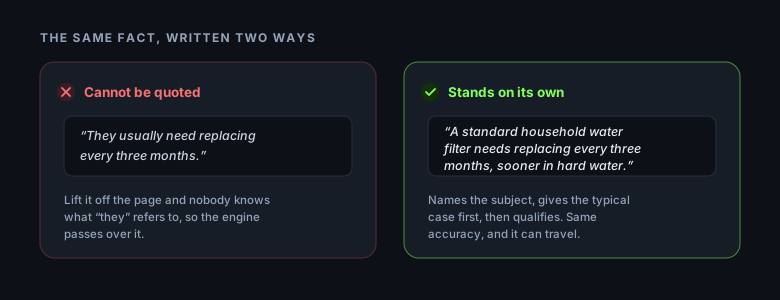
A section headed "Filter maintenance" opens by explaining that water quality varies by region, that maintenance is important for performance, and that many factors affect filter life. The actual answer, every three months for typical household use, appears in the fourth paragraph.
This page can rank. It cannot easily be quoted, because a system extracting the top of that section gets three sentences of preamble containing no answer.
After
The heading becomes "How often should I replace a water filter." The first sentence reads: replace a standard household filter every three months, or sooner if you notice reduced flow or a change in taste. The regional variation and the contributing factors follow underneath, where they belong.
Same information, same length, same page. One version is quotable and the other is not, and the only change was the order.
Where this fits alongside product pages
Product pages rarely get cited, which surprises stores that have invested in them. An assistant asked to recommend a water filter wants a source that compares options and explains criteria, and a page selling one filter does neither.
What gets cited is the content around the product: the comparison, the guide, the explanation of how to choose. Those pages then link to the product. It mirrors the classic pattern where content ranks for the research question and passes the reader to the page that sells.
This is why stores with no content struggle in AI answers regardless of how good their product pages are. There is nothing on the site shaped like an answer to the question being asked.
AEO and SEO compared
Classic SEO
AEO
Goal
Rank in a list
Be quoted in an answer
Unit
The page
A passage
Main lever
Authority and links
Clarity and specificity
Second place
Still gets clicks
Gets nothing
New sites
Wait months
Can compete now
Measurement
Position tracking
Citation sampling
Content length
Depth helps
Depth helps, padding hurts more
The overlap is large and the emphasis differs. If you had to choose one thing to change, it would be structure: the same facts reorganised so each answer stands alone will outperform the same page with more words added.
Measuring it
Position tracking cannot answer whether you are cited, because a citation is not a position. The workable method is sampling: write down the twenty questions your buyers actually ask, put them to the assistants on a schedule, and record whether you appear and how you are described.
Do it repeatedly. Answers vary between sessions and drift as models update, so a single check is noise. The same twenty questions asked weekly produces a trend you can act on.
Track how you are described as well as whether you appear. Being cited with a stale claim about your pricing or shipping is worse than not being cited, and it is only fixable once you know it is happening.
How long it takes
Faster than classic ranking, and not instant. A page becomes eligible for retrieval once indexed, so citations can begin within weeks rather than the months a competitive ranking demands. Consistency is the slower part: appearing once in one session is noise, and appearing reliably across sessions and engines is the real goal.
Expect variance that would look broken in a rank tracker. The same question asked twice in an afternoon can return different sources. Treat it like polling, where the trend across many samples is the signal and any single answer is not.
Common mistakes
Treating AEO as a separate content programme. It is the same content, structured better. A parallel effort duplicates work.
Inventing FAQs nobody asks. Twenty fabricated questions dilute the handful that match real queries.
Schema that does not match the page. The most damaging item on this list and the easiest to do by accident.
Optimising per engine. The requirements overlap almost completely. Write once, structure well.
Hiding instructions for models in the page. It does nothing useful and resembles cloaking.
Assuming a mention is a recommendation. Being named is not being recommended as the answer.
Where to start if you have limited time
You do not need to rewrite a site. Three passes, in this order, capture most of the available gain.
First, find the pages already receiving impressions for question-shaped queries. Those are pages a search engine already understands and considers relevant, which makes them the cheapest candidates: the retrieval half is solved and only the quotable half is missing.
Second, reorder the opening of each section on those pages so the answer comes first. This is editing rather than writing, it takes minutes per section, and it is the single highest-return change available.
Third, add FAQ markup to the pages where you have genuine questions and answers, generated from the same source as the visible text so the two cannot drift.
Only then consider new content. Most sites have more unrealised value in the pages they already published than in the ones they have not written.
Who this is for
This matters most if you sell something people research, if your buyers ask comparative questions, or if you are a smaller site competing against established names. That last case is where the asymmetry pays: citation rewards answering a narrow question properly, which a specialist does better than a generalist.
It matters less for purely transactional or local businesses where discovery happens through maps and marketplaces rather than research.
Final thoughts
Answer engine optimization is not a replacement for SEO and not a fad requiring a separate budget. It is a shift in what the work optimises for: from accumulating enough authority to outrank, toward being the clearest answer available to a specific question.
That shift favours precision over scale, which is unusually good news for smaller stores. The pages that win are the ones that answer properly, and most sites are still writing to fill space.
Frequently asked questions
What is answer engine optimization?
Answer engine optimization is making your pages the source that AI systems quote when answering questions, across ChatGPT, Perplexity, Google AI Overviews and similar. It differs from classic SEO in that you compete to be cited in an answer rather than to hold a position in a list of links.
Is AEO different from SEO?
They overlap heavily and the emphasis differs. Classic SEO rewards accumulated authority and ranks whole pages, while AEO rewards precision and quotes individual passages. The practical difference is that a page can rank well and still contain no passage clean enough to be quoted.
How do AI engines decide which sources to cite?
They search, retrieve a handful of candidate pages, and compose an answer from what they find. So a page must first be retrievable, meaning indexed and readable as text, and then quotable, meaning it contains a passage that answers the question completely enough to stand alone.
Can a small site win at answer engine optimization?
Often more easily than at classic ranking. Citation rewards answering a specific question better than anyone else rather than accumulated domain authority, so a specialist covering a narrow question properly can be cited without ranking first for anything.
Does FAQ schema help with AEO?
Yes, because it tells a machine exactly which passage answers which question without needing to parse the page. The requirement is that the schema matches the visible text exactly, since mismatched FAQ markup risks a manual action that costs more than the markup gains.
How do I measure answer engine optimization?
Sample rather than track positions, since a citation is not a position. Ask the assistants the questions your buyers ask, on a regular schedule, and record whether you appear and how you are described. Answers vary between sessions, so trends across many samples are what matter.
Should I optimise separately for ChatGPT and Perplexity?
No. Both retrieve sources and compose answers in broadly the same way, so the structural work that earns a citation in one tends to earn it in the others. Write once and structure well rather than maintaining per-engine variants.
Does being cited by an AI engine bring traffic?
Sometimes, and often less than a comparable search ranking would, since a reader whose question is fully answered may not click. The citation still carries your brand into the answer, which is why being the cited source matters even when the click does not follow.