Ecommerce SEO: The Fundamentals That Decide Whether Stores Rank
Online stores fail at SEO in a handful of predictable ways. Knowing which ones apply to you is most of the work.
Why stores are harder to rank than other sites
An online store carries structural disadvantages that a blog or a service business does not. Recognising them early saves a lot of effort spent on tactics that were never going to work.
The first is scale. A store with 500 products has at least 500 pages that all look broadly similar to a search engine, most of them competing for closely related terms. A consultancy with twelve pages never faces this problem.
The second is thinness. Product pages are short by nature, and much of what they contain came from the manufacturer, which means dozens of other retailers have the identical text. The third is intent. Most searches in any category are informational, and a store that only publishes product pages has nothing to offer for those searches at all.
None of these are fatal. They are simply the specific shape of the problem, and the fixes are well understood.
Getting the architecture right
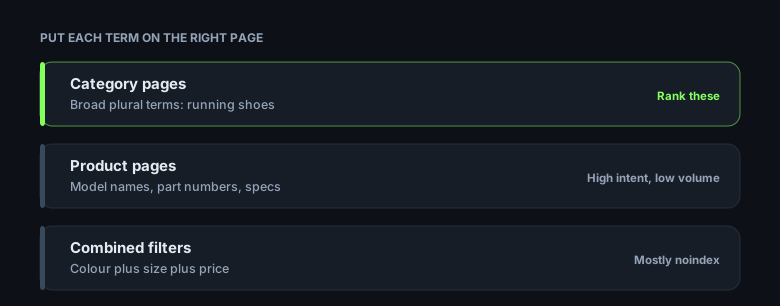
Categories carry the commercial terms
The valuable terms in most categories are plural and general: running shoes, espresso machines, dog beds. Those belong to category pages, not products. A store that treats categories as filtered lists rather than pages worth ranking gives away its best opportunity.
Products carry the specific terms
Model names, part numbers, precise specifications. Low volume individually, high intent, and they add up. The mistake is trying to rank a product page for the category term, which almost never works.
Depth costs you
Anything more than three clicks from the home page tends to be crawled less and ranked worse. Deep hierarchies feel tidy and cost visibility. Flatter is better, even when it feels less organised.
One page per intent
If two categories target the same search, they compete with each other and both underperform. Merge them, or make each one clearly distinct in what it covers.
Making product pages worth ranking
This is where most of the available gain sits, because most stores have never touched it.
Replace manufacturer descriptions. If the text came in a spreadsheet, so did everyone else's. Rewriting is tedious and it is also the single highest-return task available to most stores.
Answer the questions buyers ask. Sizing, compatibility, what is in the box, how it compares to the obvious alternative. Your support inbox already contains this list.
Say who it is wrong for. Counter-intuitive and effective. It builds trust, reduces returns, and produces the specific language people actually search.
Use real photographs. Manufacturer images are shared by every competitor. Your own are not, and they help conversion regardless of search.
Keep reviews on the page. They add unique text continuously and answer questions you did not think to answer.
You cannot do this for 500 products at once, and you should not try. Rank your products by revenue, take the top thirty, and work through them properly. The tail can wait, and much of it never justifies the effort.
Want this done for you?
Rankmore writes the cluster, links it, and tracks the rankings.
Most category pages consist of a heading and a grid. That gives a search engine almost nothing to work with, on the pages targeting the most valuable terms in the store.
Write an introduction that helps
Two or three paragraphs above the grid explaining what the category covers and how to choose between the options. Written for a buyer who does not yet know what they want, which is most of the people arriving.
Add a buying guide below the grid
Below the products so it does not obstruct anyone ready to buy. This is where you cover the trade-offs, the common mistakes, and the questions that come up repeatedly.
Answer the category questions
A short FAQ handling the five questions buyers ask about this category. These are frequently the exact phrases people search, and they feed AI summaries well.
Link to related categories
Both for shoppers who are in the wrong place and to spread authority across your category pages, which are the pages that most need it.
Filters, facets and the pages you did not mean to create
Faceted navigation quietly creates enormous numbers of URLs. Colour, size, price, brand and sort order combine into thousands of near-identical pages, and crawl budget gets spent on combinations nobody searches for.
Page type
Should it be indexed
Why
Main category
Yes
Targets the primary commercial term
Single popular facet
Sometimes
Index only where people search it, like "waterproof walking boots"
Two or more facets combined
No
Search volume is negligible, count of URLs is not
Sort order
No
Same products, different sequence
Pagination
Yes, self-canonical
Products on page four need a route to be found
The rule that keeps this manageable: index a facet only if you would be willing to write an introduction for it. If the combination does not deserve unique copy, it does not deserve to be indexed.
Out of stock and discontinued products
Every store faces this and most handle it badly, usually by deleting the page. That destroys any ranking and links it had earned, and it produces a 404 for anyone arriving from search.
Temporarily out of stock
Keep the page live and indexed. Say when it is expected back and offer an alert. Removing a page that will return means rebuilding its position from nothing.
Discontinued with a replacement
Redirect to the replacement, permanently. The search demand for the old model persists for years and it should land somewhere useful.
Discontinued with no replacement
Redirect to the parent category. Less ideal, better than a 404, and it keeps whatever authority the page had.
Seasonal products
Never delete these. Keep the page year round and update it ahead of the season, so it holds its position rather than starting again each year.
The content most stores never publish
The searches that lead to purchases usually happen before anyone knows what they want to buy. Somebody searching how to choose a running shoe for flat feet is closer to a purchase than most people searching a product name, and a store with only product pages is absent from that search entirely.
What works is unglamorous: buying guides, comparisons, how-to and maintenance content, and honest assessments of when something is the wrong choice. Written by somebody who has handled the products and dealt with the complaints, which is an advantage no generalist publisher has and most stores never use.
This is also the content AI assistants draw on when answering the questions your buyers ask. A store with no informational content is invisible to those systems for the same reason it is invisible in traditional search: there is nothing there to reference.
Technical foundations that actually matter
Speed on mobile. Store templates accumulate apps and scripts. Audit what is loading and remove what is not earning its place.
One URL per product. Products reachable through several category paths create duplicates unless the canonical is consistent.
Product schema. Price, availability and reviews, matching what is on the page. It affects how your listing appears, which affects clicks.
Clean internal linking. Products should link to their category, categories to related categories, and guides to both.
A sitemap that reflects reality. Including pages you have blocked from indexing sends contradictory signals.
How long ecommerce SEO takes
Longer than most stores expect, and the order of results is fairly predictable. Rewritten product pages tend to move first, within four to eight weeks, because the pages are already indexed and you have simply given them something unique to rank on.
Category pages move next, usually three to six months, since the terms are more competitive and the page has to earn its way past established competitors. New informational content is slowest of all, often six months before it contributes meaningfully, which is exactly why it gets abandoned by stores that started it late and expected quick returns.
The sequence matters more than the timeline. Starting with product pages gives you early movement that funds the patience the rest requires.
Mistakes that waste the most time
Chasing head terms too early
A new store targeting a term dominated by marketplaces and national retailers will spend a year losing. The specific, narrower terms underneath it convert better and are winnable now.
Publishing thin content at volume
Fifty short posts written to a keyword list perform worse than five thorough guides. Volume without substance dilutes the site rather than strengthening it.
Treating SEO as separate from merchandising
Category structure, product naming and filtering are SEO decisions as much as they are shop decisions. When those are set without reference to how people search, no amount of later optimisation fully recovers it.
Never measuring by page type
Product, category and guide pages behave differently and improve on different timelines. Aggregate traffic hides all of it, so a category improvement can be masked by a seasonal product decline and abandoned as a failure.
Where to start
Rewrite the descriptions on your top thirty products by revenue.
Add introductions and buying guides to your top five category pages.
Decide which facet combinations get indexed and block the rest.
Fix how out-of-stock and discontinued products are handled.
Publish the five guides that answer what buyers ask before choosing.
In that order, because it runs from most valuable to least, and because the first two items alone move more stores than everything else on the list combined.
Final thoughts
Ecommerce SEO is less about tactics than about doing a small number of unexciting things properly. Unique product copy, category pages that help people choose, sensible handling of the pages that come and go, and content for the searches that happen before anyone is ready to buy.
Stores that struggle are rarely missing a technique. They are usually running a catalogue where the text arrived in a spreadsheet and nothing has been written since.
Frequently asked questions
Why is ecommerce SEO harder than other kinds?
Stores carry three structural problems: hundreds of similar pages competing for related terms, product descriptions duplicated from manufacturers across every retailer, and most category searches being informational rather than transactional.
Should category or product pages target the main keyword?
Category pages. The valuable terms in most categories are general and plural, like running shoes or espresso machines, and those belong to a category page. Product pages should target model names and specific terms instead.
Do I need to rewrite every product description?
No. Rank products by revenue and rewrite the top thirty properly rather than touching all of them badly. Manufacturer text appears on every competing retailer, so rewriting is high-return, but the long tail rarely justifies the effort.
How should I handle faceted navigation?
Index the main category and single facets people genuinely search, and block combined facets, sort orders and everything else. A useful rule: index a facet only if you would be willing to write a unique introduction for it.
What should I do with out-of-stock products?
Keep temporarily unavailable products live and indexed with a restock note. Redirect discontinued products to their replacement, or to the parent category if there is none. Deleting the page destroys its rankings and links.
How much content do category pages need?
Two or three paragraphs above the product grid explaining how to choose, plus a buying guide and short FAQ below it. Category pages target the most valuable terms in the store and usually contain only a heading and a grid.
Is blogging worth it for an online store?
Yes, when it answers what buyers ask before choosing rather than publishing company news. Buying guides, comparisons and maintenance content reach people earlier in the decision, and they are what AI assistants draw on too.
What technical issues matter most for stores?
Mobile speed, since store templates accumulate apps and scripts, and one canonical URL per product where products sit in several categories. Product schema and consistent internal linking matter next, followed by an accurate sitemap.