Internal Linking for Online Stores: Where Authority Goes and Why
Internal links decide which of your pages search engines take seriously. Most stores send all of it to the wrong places.
What internal links actually do
Internal links do three jobs at once, and stores tend to think about only the first.
They help people find things, which is the obvious one. They also tell search engines how pages relate to each other and what each page is about, largely through the link text. And they distribute authority: a page that many other pages link to is treated as more important than one nothing points at.
That third job is where stores lose most. Authority arrives at the home page and a handful of guides, then gets spread evenly across hundreds of products by the navigation, so nothing accumulates anywhere in particular. Deciding where it should concentrate is most of the work.
Where authority should go
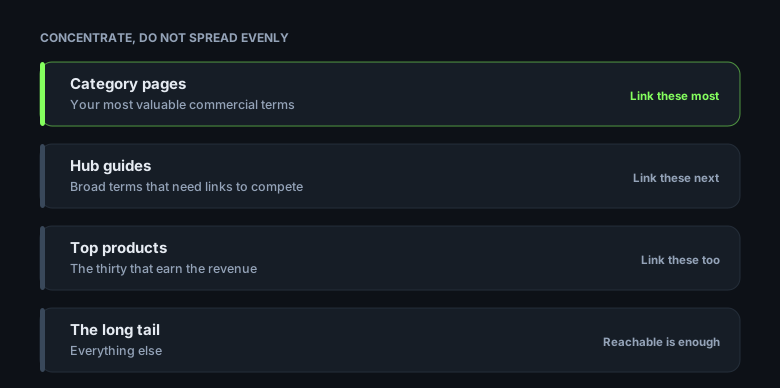
Category pages first
Categories target the most valuable commercial terms in the store and they are the pages most likely to convert a general search. They should be the best-linked pages on the site after the home page, and in many stores they are not.
Hub guides second
The pages targeting broad informational terms need concentrated links to compete, because they are up against publishers with far more of them. Every spoke pointing at its hub is what makes this work.
Priority products third
Not every product, which is impossible and pointless. The thirty that generate most of the revenue, linked from guides, categories and related-product blocks.
Everything else last
The long tail of products needs to be reachable and crawlable. It does not need concentrated authority, and trying to give it any dilutes what the important pages receive.
The links most stores are missing
Guides to products. A buying guide that never links to what you sell is a content marketing exercise with no commercial purpose.
Products to guides. Somebody on a product page who is not ready to buy will leave unless there is something useful to read.
Categories to related categories. Cheap to add, helps shoppers who landed in the wrong place, and spreads authority across the pages that need it.
Guides to other guides. This is what turns a collection of posts into a cluster.
Products to their category. Often only present in a breadcrumb, which is weaker than a contextual link.
Want this done for you?
Rankmore writes the cluster, links it, and tracks the rankings.
The words inside a link tell search engines what the destination page is about. It is one of the clearest signals available and it is routinely wasted.
Link text
Verdict
Why
click here
Wasted
Describes nothing, and unhelpful with a screen reader
read more
Wasted
Same problem, appears on every page
this guide
Weak
Slightly better, still no subject
our guide to burr grinders
Good
Names the topic, reads naturally
burr grinder buying guide 2026 best
Bad
Stuffed, reads as manipulation
The target is descriptive and natural. Vary the phrasing across links to the same page rather than repeating an identical string, which looks automated because it usually is.
Depth and how quickly pages get found
Click depth is the number of clicks from the home page to reach a page. Pages three clicks deep get crawled regularly. Pages six clicks deep may be crawled rarely, and some are effectively invisible even though they are technically reachable.
In stores this is usually caused by pagination. If a category has forty pages of products and the only route to page thirty-eight is clicking through, the products on it are extremely deep. Load-more buttons that never change the URL are worse, since there may be no crawlable route at all.
The practical fixes are unglamorous: keep hierarchies shallow, avoid deep pagination by splitting large categories into meaningful sub-categories, and make sure paginated pages carry real links rather than script-driven loading.
Related products, done properly
Most stores show related products automatically and never examine what is being shown. Two things are worth checking.
First, whether the relationships make sense. Automatic blocks frequently surface items that share a tag but nothing else, which helps nobody and produces links that mean little.
Second, whether they are genuinely links. Blocks loaded by script after the page renders may not be seen at all, so they contribute nothing beyond the visual.
Complements usually beat substitutes here. Somebody looking at a camera is better served by lenses and bags than by three other cameras, and the commercial result is better too.
Auditing what you have
List your most important pages. Top categories, hub guides, priority products. Twenty or so.
Count internal links to each. A crawler will do this, and most have a free tier sufficient for a small store.
Find the mismatches. Important pages with few links, and unimportant pages with many.
Check your orphans. Pages with no internal links at all. Every store has some, usually old products and forgotten posts.
Fix in order of value. Add contextual links from relevant pages, not a block of links at the bottom of everything.
Once a quarter is enough. Internal linking degrades slowly as products are added and removed, and a quarterly pass keeps it from drifting far.
How much is too much
There is no fixed limit worth quoting, but there is a sensible test: would you include this link if search engines did not exist? A link that helps a reader is fine. A link inserted purely to route authority reads as exactly that, and it dilutes the links that were doing real work.
Concentration beats volume. Ten well-placed contextual links to a category page do more than a hundred identical footer links, because footer links appear everywhere and are discounted accordingly.
Navigation, breadcrumbs and the links you get for free
The main navigation
Every page links to whatever is in the header, which makes those links powerful and also means they are shared out thinly. A navigation listing forty categories gives each one a fortieth of the effect. Listing your eight genuine priorities concentrates it, and it is easier to use.
Breadcrumbs
Cheap, useful to shoppers, and they give every product a consistent link to its category. Add breadcrumb schema and they can appear in search results too, which improves click-through.
Pagination
Paginated pages should link to each other with ordinary crawlable links. Numbered links to nearby pages plus first and last is enough. Infinite scroll with no URL change leaves the products effectively unreachable.
The home page
Usually the strongest page on the site, and often spent on a carousel and a promotion. A handful of contextual links to your priority categories and hub guides is the highest-value placement available anywhere on the site.
Handling products that come and go
Catalogues change constantly and internal linking is where that damage accumulates quietly. A discontinued product does not just lose its own page; every link pointing at it becomes a link to a 404 or, at best, a redirect.
Redirect chains are the version people miss. A product redirects to its replacement, which is itself later replaced and redirects again. Each hop loses a little, and the links on your own pages are still pointing at the original. Updating the source links rather than relying on the redirect keeps the value intact.
A quarterly crawl catches this. Look for internal links returning anything other than a direct 200, and repoint them at the current URL. It is dull, mechanical work and it recovers value that was already paid for.
What to expect after fixing it
Internal linking changes move faster than most SEO work, because nothing has to be crawled for the first time and no new content has to earn trust. Pages that gained links commonly move within four to six weeks of the next crawl.
The size of the movement depends on where the page started. A category page sitting on the second results page with almost no internal links can move substantially. A page already ranking well is unlikely to shift much, since links were not what was holding it back.
What you should not expect is a change in total links to the site. Internal linking redistributes what you already have rather than adding to it, so a page that gains will often be balanced by pages that quietly lose a little. That is the intended outcome: concentration on what matters, at the expense of pages that were never going to earn anything.
Common mistakes
Stuffing the footer. Site-wide links carry little weight and clutter every page.
Linking only from the bottom of articles. Contextual links inside the text carry more weight and get clicked far more.
Identical link text everywhere. Vary it naturally.
Leaving orphaned pages. If nothing links to a page, it is barely part of the site.
Ignoring redirect chains. Internal links pointing at redirected URLs leak value. Update the links rather than relying on the redirect.
Linking every mention of everything. When a paragraph has six links, none of them means much.
Final thoughts
Internal linking is the cheapest work in SEO. It needs no new content, no outreach and no budget, and it is entirely within your control, which is unusual in this field.
Decide which twenty pages matter, make sure they are well linked from relevant places with descriptive text, and check the orphans quarterly. That is the whole discipline, and doing it deliberately puts most stores ahead of competitors who have never thought about it at all.
Frequently asked questions
Why does internal linking matter for SEO?
Internal links help people navigate, tell search engines what a page is about through the link text, and distribute authority across the site. The third job is where stores lose most, by spreading it evenly instead of concentrating it.
Which pages should get the most internal links?
Category pages first, since they target the most valuable commercial terms, then hub guides that need concentrated links to compete for broad terms, then your top thirty products by revenue. The long tail needs to be reachable, not prioritised.
What link text should I use?
Descriptive and natural, like our guide to burr grinders rather than click here or read more. Vary the phrasing across links to the same page instead of repeating an identical string, which reads as automated because it usually is.
What is click depth and why does it matter?
It is how many clicks from the home page a page takes to reach. Pages three clicks deep get crawled regularly; pages six deep may be crawled rarely. Deep pagination in large categories is the usual cause in stores.
Are automatic related-product blocks useful?
Only if the relationships make sense and the links exist in the page rather than being loaded by script afterwards. Complements like lenses and bags usually serve a shopper better than showing three more of the same product.
How many internal links is too many?
There is no fixed number worth quoting. The test is whether you would include the link if search engines did not exist. Concentration beats volume, since ten contextual links outperform a hundred identical footer links.
How do I find orphaned pages?
Run a crawler over the site and compare the pages it finds against your full page list. Anything in the list but not reachable by crawling has no internal links. Old products and forgotten posts are the usual candidates.
How often should I audit internal links?
Once a quarter is enough for most stores. Internal linking degrades slowly as products are added and removed, so a quarterly pass catches drift before it becomes a large job.