Ecommerce Blog Strategy: What to Publish and What to Skip
Most store blogs publish news nobody searches for. Here is what earns traffic, and how to tell whether it is paying for itself.
Why most store blogs fail
Walk through the blog of almost any online store and you will find the same pattern: a burst of posts around launch, a few company announcements, a seasonal post or two, then silence for eighteen months.
The reason is not laziness. It is that nobody decided what the blog was for. Posts get written because publishing seemed like the right thing to do, and when the traffic does not arrive the effort stops. Which is reasonable, because the traffic was never going to arrive for posts about a new arrival nobody was searching for.
A store blog earns its keep when every post answers a question people are genuinely asking. That is a narrow definition and it rules out most of what stores publish, which is precisely why it works.
What to publish
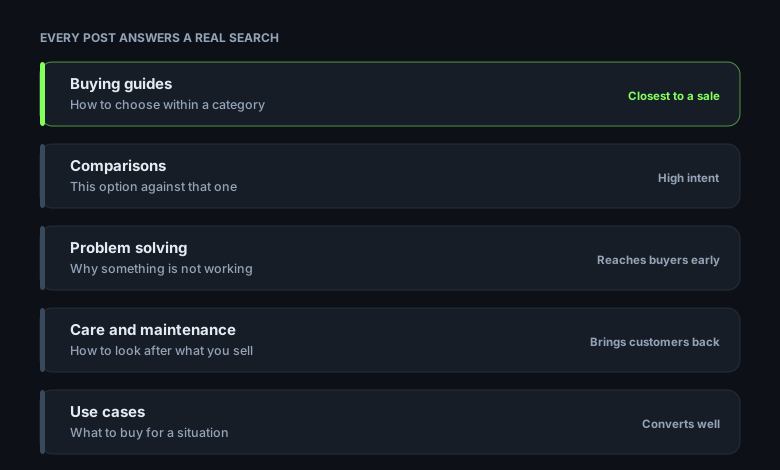
Buying guides
How to choose within a category. These reach people at the moment they are deciding, and they are the closest informational content gets to a sale. Every category you care about should have one.
Comparisons
This against that. High intent, frequently searched, and an area where a store that handles both products has a real advantage over a publisher who has handled neither.
Problem solving
Why something is not working and how to fix it. These reach people before they know what product they need, which is earlier in the journey than most stores ever get.
Care and maintenance
How to look after what you sell. Reaches existing customers, reduces support load, and produces repeat visits from people who have already bought from you once.
Specific use cases
What to buy for a particular situation. Narrow, low volume, and unusually likely to convert because the searcher has already described their own requirements.
What to skip
Company news. Nobody searches for it. Put it on an updates page if you need one.
New product announcements. The product page covers this. A post about it competes with the page you actually want ranking.
Industry commentary. Publishers do this better and your buyers are not looking for it from you.
Listicles with no substance. Ten tips that could apply to any store in any category read exactly as generic as they are.
Anything you cannot write from experience. If it has to be researched from scratch, a publisher will do it better and you have no advantage.
The test worth applying before writing anything: can you name the search somebody would type to find this? If not, it is not a blog post, whatever else it might be.
Want this done for you?
Rankmore writes the cluster, links it, and tracks the rankings.
Frequency matters far less than consistency and completeness. One thorough guide a month, sustained for a year, beats twenty rushed posts in January followed by nothing. The pattern that fails is the burst, and it fails because the site never accumulates depth on any subject.
Planning a year of posts in an afternoon
Open your support inbox. Read the last hundred pre-sale questions and write down every distinct one.
Group them by topic. Most will cluster into three or four subjects, which is where your clusters come from.
Check they are searched. A keyword tool is useful here, but the volume matters less than confirming people phrase it the way you assumed.
Order by proximity to a purchase. Buying guides and comparisons first, general interest last.
Assign dates. A published calendar is what turns intentions into posts.
The reason this beats keyword research alone is that support questions are real language from real buyers. Keyword tools show you what has volume; your inbox shows you what stops a sale, and those are not the same list.
Making posts lead somewhere
A post that earns traffic and sends nobody toward a product has cost you money. Not because every post must sell, but because there is no reason to leave the connection out.
Link to the relevant category and to specific products where they are genuinely the right recommendation. Do it in context, inside the paragraph where the recommendation makes sense, rather than as a banner at the end that readers have learned to ignore.
Recommend honestly, including when the cheaper option is the right one. Readers can tell the difference between a guide and an advertisement, and the guides are the ones that get linked to, shared, and cited by AI assistants.
Structure that helps
Answer the question early
Somebody who searched a question wants the answer, not eight paragraphs of throat-clearing. Give the short answer near the top, then explain properly for the people who want the reasoning.
Descriptive headings
Headings phrased as the questions people ask. Better for skimming, and it is what lets sections be pulled into search features and AI summaries.
Sections that stand alone
Each section should make sense to somebody who arrived at it directly, because with anchor links and AI extraction that is increasingly what happens.
Enough length to settle it
Long enough to answer the question fully, and no longer. Padding a 700 word answer to 2,000 words helps nobody and readers leave, which is itself a signal.
Measuring whether it works
Blog traffic on its own is a vanity number. Three measures tell you more.
Traffic to posts that link to products, separated from general interest posts. Only one of those categories can convert.
Assisted conversions. Most people do not buy on the visit where they read a guide. Attribution that ignores this makes every guide look worthless.
Rankings on the questions you targeted. The earliest signal, visible well before the traffic becomes meaningful.
Give it six months before judging. Informational content is slow, and stores that quit at month three quit just before the compounding starts, which is the single most common way this fails.
Who should write it
The owner, usually
Whoever answers the support emails knows more about what buyers actually get wrong than any writer you could hire. The writing may be rougher and the substance will be better, and substance is the harder half.
A freelancer, with supervision
Workable if you supply the substance and they supply the prose. What fails is handing over a keyword list and expecting expertise to appear, because it produces the same generic article every competitor has.
AI, as a first draft
Useful for structure and for getting words on the page, provided somebody who knows the subject then corrects it and adds what only you know. Published unedited it reads exactly like what it is.
Nobody, for now
A legitimate choice. If you cannot sustain a post a month, spend the time on product and category pages instead, where the return is faster and does not depend on continuing.
Reviving a blog that has gone quiet
If you already have twenty half-forgotten posts, start there rather than with new writing. Old posts are already indexed, which is the slow part, and improving them usually pays back faster than starting from nothing.
Work through them in three passes. First, delete or merge anything genuinely worthless, such as old announcements and duplicate coverage of the same question. Second, take the posts that still get impressions and rewrite them properly: move the answer to the top, add the detail that was missing, and update anything now inaccurate. Third, add the internal links that were never there, both to products and between related posts.
This is usually a week of work and it frequently produces more than the following six months of new posts would. It also tells you which subjects your site already has some traction on, which is the best possible guide to what to write next.
Common mistakes
Publishing without a question in mind. If nobody would search it, nobody will find it.
Starting strong and stopping. Six posts then silence is the standard pattern and it produces nothing.
Never linking to products. The traffic has to lead somewhere.
Writing what a publisher writes. Compete where handling the products is an advantage, not where it is not.
Judging at three months. Too early. The curve is slow and then it is not.
Chasing volume over relevance. A popular topic unconnected to what you sell brings visitors who were never going to buy.
Where the blog fits with everything else
A blog is not a separate project from the rest of your SEO, and treating it as one is why it so often sits in a corner producing nothing. Posts should point at categories and products, categories should point back at the relevant guides, and related posts should link to each other so the group reads as depth on a subject rather than a pile of articles.
Done that way the blog stops being a cost centre and becomes the part of the site that reaches people before they are ready to buy, then hands them onward when they are.
Final thoughts
A store blog works when it stops being a blog and becomes a set of answers. Read your support inbox, write the answers properly, connect them to what you sell, and keep going past the point where it feels like nothing is happening.
The stores that win here are not the ones publishing most. They are the ones that picked three subjects they genuinely know, covered them thoroughly, and were still publishing in month twelve.
Frequently asked questions
Why do most store blogs fail?
Because nobody decided what the blog was for, so posts get written about company news and new arrivals that nobody searches. The traffic never arrives, the effort stops, and the blog sits unused after six or so posts.
What should an online store blog about?
Buying guides, comparisons, problem solving, care and maintenance, and specific use cases. The test before writing anything is whether you can name the search somebody would type to find it. If not, it is not a post.
How often should a store publish?
Consistency matters more than frequency. One thorough guide a month sustained for a year beats twenty rushed posts in January followed by silence. Fortnightly suits most owner-written blogs; sporadic publishing never compounds.
How do I find topics to write about?
Read the last hundred pre-sale questions in your support inbox and write down every distinct one. Support questions are real buyer language showing what stops a sale, which is a different list from what a keyword tool shows.
Should blog posts link to products?
Yes, in context inside the paragraph where the recommendation makes sense, rather than as a banner at the end. Recommend honestly, including when the cheaper option is right, since readers can tell a guide from an advertisement.
How long should posts be?
Long enough to answer the question fully and no longer. Padding a 700 word answer out to 2,000 words helps nobody, and readers leaving early is itself a negative signal. Depth should come from covering the question, not from volume.
How do I measure whether a store blog is working?
Separate traffic to posts that link to products from general interest posts, track assisted conversions since few people buy on the same visit, and watch rankings for the questions you targeted, which move first.
How long before a store blog shows results?
Give it six months before judging. Informational content builds slowly and then compounds. Stores that quit at three months typically quit just before the returns start, which is the most common way this fails.