Topic Clusters for Online Stores: Hub Pages, Spokes and Why They Work
One thorough hub page, several supporting articles, and links running between them. The structure that turns scattered posts into something that ranks.
What a topic cluster is
A cluster is one substantial page covering a topic broadly, plus a set of narrower pages covering its parts in depth, with links running between them. The broad page is the hub, the narrow ones are spokes, and every spoke links back to the hub.
Put plainly: instead of publishing twelve unrelated posts across a year, you publish one thorough guide and eleven pieces that each go deeper on one aspect of it, all connected. Same effort, considerably better outcome.
The reason it works is that search engines assess topical strength, not just page quality. A site with one page about coffee grinding looks incidental. A site with a main guide and eight connected pieces on burr types, grind sizes, cleaning, and troubleshooting looks like a source on the subject, and that assessment lifts every page in the group.
Why scattered posting fails
Nothing accumulates
Unconnected posts on unrelated topics each start from nothing. There is no compounding, so a year of publishing produces a year of individually weak pages.
Authority has nowhere to flow
When one post earns links, that value stays put instead of strengthening related pages. In a cluster it flows to the hub and out across the group.
Pages compete with each other
Write three posts that all half-cover the same subject and search engines cannot tell which to rank, so they often rank none of them well. Keyword cannibalisation is nearly always a symptom of missing structure.
Readers leave
A post with no obvious next step ends the visit. A cluster gives every page somewhere useful to go, which keeps people on the site and reaching pages closer to a purchase.
Choosing the topic
Cluster selection decides most of the outcome, and the criteria are narrower than people expect.
It must connect to what you sell. A cluster about a subject adjacent to your catalogue brings traffic that never buys.
It needs genuine sub-questions. If you cannot list eight distinct questions people ask, it is a page rather than a cluster.
You need real knowledge. Clusters written from research read like research. The advantage a store has is handling the products and dealing with the complaints.
The searches should be informational. Clusters serve people deciding, not people ready to check out.
Most stores can support three to five clusters. Trying to run twelve produces twelve shallow ones, which is the scattered-posting problem wearing a better name.
Want this done for you?
Rankmore writes the cluster, links it, and tracks the rankings.
The hub covers the whole topic at a level that satisfies somebody who knows nothing, while pointing to the spokes for depth.
Cover everything, settle nothing entirely
Each sub-topic gets a section that genuinely answers the question, then links to the spoke for people who want more. A hub that covers nothing is thin; a hub that exhausts every sub-topic leaves the spokes with nothing to do.
Structure it for extraction
Descriptive headings phrased as the questions people ask, with the answer in the first sentence beneath. This is what makes hub pages perform well in AI summaries as well as ordinary search.
Link to every spoke
From the relevant section, using the spoke's topic as the link text. Not a list of related links at the bottom, which readers skip and which tells search engines less about the relationship.
Make it the destination
The hub is the page you link to from category pages, from the navigation, and from anywhere else the topic comes up. Concentrating internal links on one page is what lets it compete for the broad term.
Building the spokes
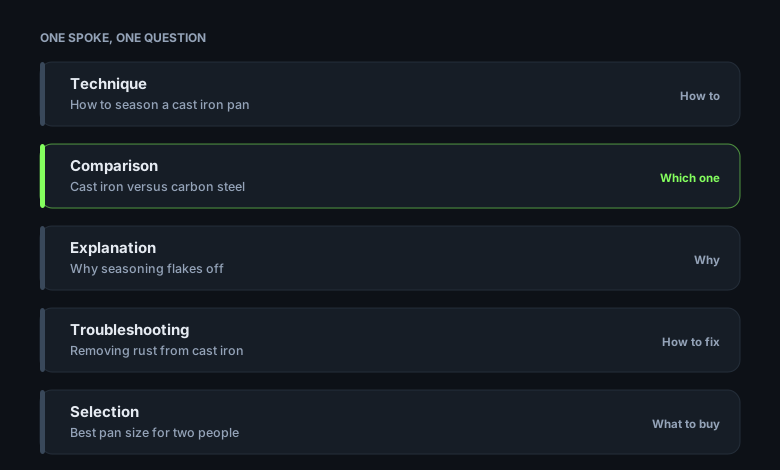
Spoke type
Answers
Example
Technique
How to do something
How to season a cast iron pan
Comparison
Which option to choose
Cast iron vs carbon steel
Explanation
Why something happens
Why seasoning flakes off
Troubleshooting
How to fix a problem
Removing rust from cast iron
Selection
What to buy for a situation
Best pan size for two people
Each spoke should settle one question completely. The common failure is spokes that overlap, which recreates the cannibalisation the cluster was meant to solve. If two spokes would rank for the same search, they are one spoke.
How the linking works
The link structure is the part that makes it a cluster rather than a folder, and it is simple enough to describe in four rules.
Every spoke links to the hub, early in the page, with descriptive link text. This is the link that concentrates authority.
The hub links to every spoke, from the relevant section rather than a list at the end.
Spokes link to closely related spokes, where it genuinely helps a reader. Two or three, not everything.
Both link to products and categories where relevant, which is how the cluster earns its keep commercially.
Descriptive link text matters throughout. "Read our guide to burr grinders" tells a search engine what the target page is about. "Click here" tells it nothing, and it is worse for readers using screen readers too.
How long a cluster takes to work
Individual spokes can pick up traffic within weeks, particularly narrow troubleshooting questions with little competition. The hub is slower, since it targets the broad term, and three to six months is normal before it moves meaningfully.
The effect people underestimate is what happens after. Once a cluster is established, new spokes added to it rank faster than standalone posts ever did, because they inherit the topical strength the group has already built. The tenth spoke is easier than the first, which is the opposite of how scattered posting behaves.
Planning a cluster before writing anything
An hour of planning saves a great deal of rewriting, and the process is short enough to do on paper.
List the questions first
Write down every question a buyer asks about the topic, drawn from support tickets and pre-sale emails rather than a keyword tool. Real customer language is more specific and more useful than the phrasing tools produce.
Group them
Some questions are variations of one another and belong on a single page. Others look similar and are genuinely distinct. This grouping step is what prevents overlapping spokes later, which is the most common way clusters fail.
Assign one question per spoke
Each group becomes one spoke with one job. If a spoke needs two headings that could each be a page title, it is two spokes.
Decide what the hub keeps
The hub gets a section per spoke that answers the question adequately and links onward. Deciding this in advance stops the hub either becoming a stub or swallowing everything the spokes were meant to cover.
Worked example: a coffee equipment store
Suppose the topic is grinding coffee at home. The hub covers why grind matters, the main grinder types, how grind size relates to brewing method, and maintenance, at a level that satisfies a beginner.
The spokes then take one question each: burr against blade grinders, choosing a grind size for a specific brewing method, why a grinder produces inconsistent results, how to clean one properly, whether an expensive grinder is worth it, and what to buy on a limited budget.
Each spoke links back to the hub, the hub links out to each in the relevant section, and both link to the grinder category and to specific products where they are genuinely the right recommendation. The whole thing takes a few weeks to write and continues working for years, which is a better return than most marketing a store buys.
Common mistakes
Too many clusters at once. Three complete clusters beat eight partial ones by a wide margin.
Overlapping spokes. If two pages answer the same question, merge them.
A hub that is only a list of links. It has to stand on its own as a useful page.
Linking only from the bottom. In-context links carry more weight and get clicked.
Choosing topics by search volume alone. A high-volume topic disconnected from what you sell produces traffic and no revenue.
Abandoning it half-built. A hub with two spokes is not a cluster, and it will not perform like one.
What Rankmore builds
A Rankmore campaign produces exactly this structure: a hub guide for your chosen keyword, supporting articles across the technique, comparison and explanation types, with the internal links wired between them and back to the product or page you are promoting.
The reason it works as an automated process is that the structure is mechanical even though the writing is not. Which pages exist, what each one covers, and how they link is a pattern that can be applied consistently, which is the part stores most often get wrong when doing it by hand.
Final thoughts
Clusters are not a clever tactic. They are what publishing looks like when it is planned rather than improvised, and the advantage comes from consistency rather than novelty.
Pick a topic you genuinely know, write one thorough hub, add spokes that each settle one question, and link them properly. Then finish it before starting another, because a half-built cluster performs like the scattered posts it was supposed to replace.
Frequently asked questions
What is a topic cluster?
One substantial hub page covering a topic broadly, plus narrower spoke pages covering its parts in depth, with every spoke linking back to the hub. The structure signals topical strength, which lifts every page in the group.
Why do clusters outrank scattered blog posts?
Unconnected posts each start from nothing and never compound, authority earned by one stays put, and posts covering similar ground compete with each other. A cluster concentrates internal links on the hub and builds recognisable depth on one subject.
How many pages does a cluster need?
A hub plus at least six to eight spokes. Below that it does not read as depth on a topic and will not perform like a cluster. If you cannot list eight distinct questions people ask, the topic is a page rather than a cluster.
How many clusters should a store run?
Three to five for most stores. Attempting a dozen produces a dozen shallow ones, which is the scattered-posting problem under a different name. Finish one before starting the next, since half-built clusters do not perform.
How should hub and spoke pages link to each other?
Every spoke links to the hub early in the page with descriptive text, the hub links to each spoke from the relevant section rather than a list at the end, and spokes link to two or three closely related spokes where it helps a reader.
How do I choose a cluster topic?
It must connect to what you sell, support at least eight genuine sub-questions, and draw on knowledge you actually have. Choosing by search volume alone produces traffic from people who were never going to buy from you.
How long does a cluster take to rank?
Individual spokes can move within weeks, especially narrow troubleshooting questions. The hub targets a broader term and usually takes three to six months. Once established, new spokes added later rank faster than standalone posts would.
Does Rankmore build topic clusters?
Yes. A campaign produces a hub guide for your chosen keyword plus supporting articles across technique, comparison and explanation types, with internal links wired between them and back to the product or page being promoted.