Google AI Overviews: How to Get Your Store Into the Answer Box
AI Overviews answer the question before anyone reaches the results. Getting quoted in that box now matters more than the rank underneath it.
What changed at the top of the results
For most informational searches, Google now writes an answer and places it above the results. Links to the sources sit alongside it. Many people read the answer and stop there.
This is different from the other AI engines in one important way: it is not a separate destination. Nobody chooses to use AI Overviews. They appear inside the search people were already doing, which is why they affect far more traffic than ChatGPT and Perplexity combined.
The practical consequence is that ranking is no longer the finish line. You can hold position three and still lose the click, because the question was settled higher up the page. Being quoted in the box is the new objective, and the rank beneath it is mostly the entry ticket.
How Google picks the sources
It starts from pages that already rank
This is the crucial difference from other AI engines, and it is good news. Google draws heavily on pages already ranking well for the query and closely related ones. Traditional SEO is not obsolete here, it is the qualifying round.
It breaks the question into parts
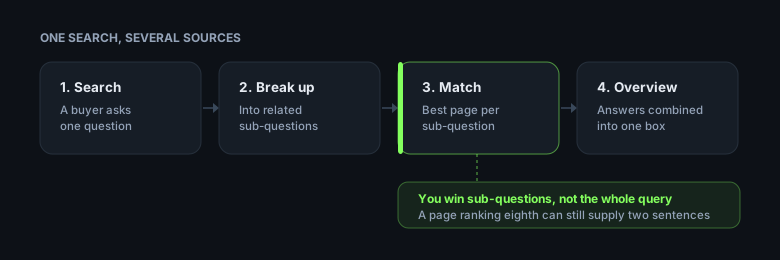
A single search is decomposed into several related sub-questions, each answered from whichever source handles it best. That is why one Overview often cites four or five different sites: nobody won the whole question, they each won a part of it.
It quotes passages, not pages
The unit that gets used is a passage that answers one sub-question cleanly. A page can rank second overall and contribute nothing, while a page ranking eighth supplies two sentences because it happened to answer a specific sub-question directly.
It favours agreement
Where sources agree, Google states the answer plainly. Where they disagree, it hedges or omits. A claim that matches the consensus and is stated crisply is more likely to be used than an unusual claim, however correct.
What this means for your store
Three consequences worth internalising before changing anything.
Rankings still matter, because they are the pool sources are drawn from. Anyone telling you to abandon traditional SEO for AI search has this backwards.
Clicks and impressions are decoupling. Impressions can hold steady while clicks fall, and that is the Overview absorbing the question rather than a ranking problem.
Sub-questions are the real targets. Optimising for "best coffee grinder" matters less than clearly answering the six questions that sit underneath it.
Want this done for you?
Rankmore writes the cluster, links it, and tracks the rankings.
The reach column is the one that matters. Overviews change the behaviour of every searcher, not just the minority who have adopted an AI assistant, which is why this is the engine to address first even though it is the hardest to measure.
Where stores usually have the most to gain
Buying guides and comparisons
These trigger Overviews constantly and sit close to a purchase decision. They are also where a specialist can genuinely outperform a generalist publisher, because you have handled returns, complaints and edge cases the publisher has only read about.
Care, maintenance and troubleshooting
Reliably question-shaped, reliably summarised, and reliably ignored by competitors who see no direct revenue in them. They also bring back existing customers, which the traffic numbers alone tend to undersell.
Sizing, compatibility and fit
Highly specific questions where a generic answer is unhelpful and yours is not. If you sell the product, you know which combinations work, and that is precisely the sort of concrete detail these summaries reach for.
Your own brand and policies
Returns, warranties, shipping, whether you are legitimate. If your own pages do not answer these plainly, Google will assemble an answer from review sites and forums instead, and you will not like all of it.
Which searches trigger an Overview
Informational questions, almost always
How, why, what, which, comparisons, definitions. If somebody is learning rather than buying, expect an Overview.
Commercial research, frequently
"Best X for Y", "X vs Y", "is X worth it". These trigger Overviews often, and they matter to stores because the buyer is close to a decision.
Transactional searches, rarely
Somebody searching for a specific product to buy usually gets shopping results instead. Your product pages are less exposed than your guides.
Your own brand, sometimes
Worth checking. If Google is summarising your brand from third-party sources rather than your own site, that is a gap to close, since the summary shapes first impressions before anyone reaches you.
Writing passages that get quoted
Answer in the first sentence under the heading
The passage that gets extracted is usually the one immediately following a heading that matches the sub-question. Preamble pushes the answer out of the extraction window.
Keep the claim self-contained
The passage is lifted out of your page and placed next to passages from four other sites. If it needs the paragraph before it to make sense, it cannot travel.
Be specific enough to be useful
"Every three to six months" is quotable. "It depends on usage" is not, even though it is often the more honest answer. Give the typical case first, then the variation.
Match the consensus, then add
State the widely agreed answer plainly, then add what you know that others do not. The agreed part earns the citation; the additional part earns the click.
Covering sub-questions properly
Since Google decomposes queries, the highest-return work is making sure each sub-question has a section that settles it.
Take your main topic and search it. Read the Overview.
Note every sub-question it answered, not just the headline one.
Check your page. Does each sub-question have its own heading and a direct answer?
Where the answer is buried inside a paragraph about something else, give it a heading of its own.
Where it is missing, add a short section rather than a new page.
This is usually restructuring rather than writing. The information tends to already be on the page, arranged in an order that suits an essay rather than an extractor.
How long changes take to show up
Slower than the other engines, because Google has to re-crawl and re-assess the page before it can be drawn on. Restructured passages on an already-indexed page typically start appearing within a few weeks, sometimes sooner on pages Google crawls often.
New pages are slower still, since they have to rank before they can be considered. That order matters: if a page is not in the top results for the query, no amount of rewriting will get it into the box. Fix the ranking first, then fix the passages.
Measuring the impact
Google does not report AI Overview appearances separately in Search Console, which makes this harder than it should be. What you can do:
Watch the impressions-to-clicks ratio. Stable impressions with falling clicks on informational queries is the signature.
Check manually. Search your main queries in an incognito window and record whether an Overview appears and who it cites.
Segment by intent. Informational pages will show the effect; product pages largely will not. Aggregating them hides it.
Track branded search. Being named in an Overview without a click often shows up later as somebody searching your brand directly.
Living with fewer clicks
Some traffic is not coming back. Queries with a short factual answer will increasingly be settled in the box, and no amount of optimisation changes that.
What is left is more valuable than what was lost. Somebody who reads the summary and still clicks through wants depth, comparison, or to buy. The visitors that disappear are the ones who wanted one fact and were never going to purchase.
The strategic response is to write for the questions that a paragraph cannot settle. Detailed comparisons, specific use cases, honest assessments of when a product is the wrong choice. Overviews summarise consensus well and handle nuance badly, and nuance is where a specialist retailer wins.
Common mistakes
Treating this as separate from SEO. Overviews draw from ranking pages. The two are the same job.
Panicking at a traffic drop without checking whether impressions held. If they did, the ranking is fine and the box took the click.
Chasing every triggering query. Some questions are simply not worth winning because the answer is one sentence and the reader never had commercial intent.
Writing thin pages to be quotable. Extraction favours clear passages, not short pages. Depth still decides whether you rank at all.
Ignoring brand queries. If Google is describing your business from someone else's page, fix that first.
Final thoughts
AI Overviews reward the same things good SEO always rewarded, with one addition: the answer has to be extractable. Rank to get into the pool, then write passages that can be lifted out and still make sense.
The stores that struggle are the ones whose content only works read start to finish. The stores that do well have pages where every section answers its own question, which happens to be better for readers too.
Frequently asked questions
What are Google AI Overviews?
They are AI-generated answers Google places above the search results for many queries, with links to the sources used. Because they appear inside ordinary searches rather than a separate product, they affect far more traffic than other AI search engines do.
Do rankings still matter with AI Overviews?
Yes, more than with any other AI engine. Google draws heavily on pages already ranking well for the query and related ones, so ranking is the qualifying round. Traditional SEO gets you into the pool that sources are selected from.
Why do AI Overviews cite several different sites?
Google breaks a search into related sub-questions and answers each from whichever source handles it best. A page can rank second overall and contribute nothing, while a lower-ranking page supplies two sentences by answering one sub-question directly.
How do I get my page quoted in an AI Overview?
Answer each sub-question in the first sentence under a heading that matches it, keep the claim self-contained so it survives being lifted out, and be specific enough to be useful. Vague answers like "it depends on usage" are not quotable.
Can I see AI Overview appearances in Search Console?
Not separately. The workaround is to watch for stable impressions with falling clicks on informational queries, which is the signature, and to check your main queries manually in an incognito window to see who is cited.
Which searches trigger an AI Overview?
Informational questions almost always, and commercial research like "best X for Y" frequently. Transactional searches for a specific product usually return shopping results instead, so product pages are less exposed than guides.
Will AI Overviews reduce my traffic?
On queries with a short factual answer, yes, and that traffic is unlikely to return. The visitors who still click after reading a summary want depth or intend to buy, so the remaining traffic converts better even as the total falls.
Should I write shorter pages to be more quotable?
No. Extraction favours clear self-contained passages, not short pages, and depth still decides whether you rank well enough to be considered at all. Restructure so each section answers its own question rather than cutting content.