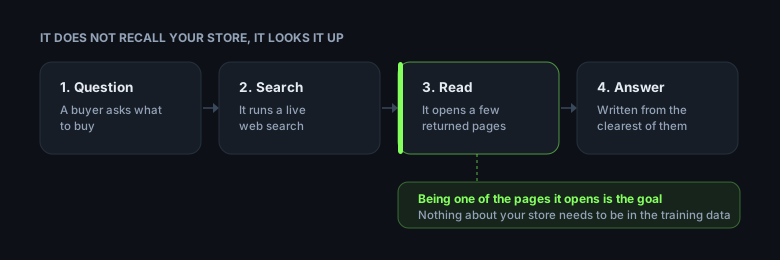
ChatGPT does not remember your store. It searches, reads a few pages, and writes an answer from them. That is the whole opportunity.
How ChatGPT actually answers a shopping question
The common assumption is that ChatGPT recommends brands it learned about during training, which would make this a problem you cannot influence. That is not how current versions handle shopping questions.
Asked which running shoes suit flat feet, or which Shopify app does a particular job, ChatGPT searches the web, retrieves a small number of pages, and composes an answer from what it just read, citing sources as it goes. Your store is competing to be one of those pages.
That distinction matters enormously. Training data is fixed and unreachable. Retrieval happens fresh each time, which means a page you publish today can be quoted tomorrow.
What decides which pages get read
Being findable
Retrieval starts with a search. If a page is not indexed, is blocked, or is slow enough to time out, it never becomes a candidate. This is ordinary technical hygiene and it is the gate everything else sits behind.
Matching the question closely
Retrieval favours pages that address the specific question rather than the general topic. A page titled for the exact question a user asked has an advantage over a broader page that covers it in passing.
Being readable as text
Content that only exists inside an image, a PDF, or a tab that loads after a click is effectively invisible. If a fact matters, it needs to be text in the HTML.
What decides which pages get quoted
Being read is not being used. Of the pages retrieved, only some end up in the answer, and the difference is usually structure rather than quality.
The answer is near the top of its section
A section that opens with context and reaches its answer three paragraphs later gives an extraction system nothing usable at the point it looks. Put the answer first and elaborate after.
The passage stands alone
If a paragraph only makes sense given the one above it, quoting it produces something confusing, so it gets skipped in favour of a competitor's cleaner passage.
The claim is specific
Concrete details survive quotation because there is something to relay. Vague superlatives do not, because repeating "high quality" tells the reader nothing.
Want this done for you?
Rankmore writes the cluster, links it, and tracks the rankings.
The two you control are the two that matter, which is a better position than most SEO problems.
A page rewritten for citation
Take a store selling coffee grinders, and the question of whether burr grinders are worth the extra money.
The version that gets read and skipped
A section headed "Burr vs blade" opens with a paragraph on the history of coffee grinding, moves to how grind consistency affects extraction, then explains that burr grinders produce uniform particles while blade grinders chop unevenly. The verdict, that burr is worth it for anyone brewing daily, arrives in paragraph four.
Everything in that section is accurate and useful to a reader who works through it. An extraction system taking the top of the section gets coffee history.
The version that gets quoted
The heading becomes "Are burr grinders worth the extra money." The opening sentence answers it: yes for anyone brewing daily, because burr grinders produce a uniform grind that blade grinders cannot, and uneven grind is the most common cause of bitter coffee. The history and the extraction detail follow underneath.
Nothing was removed and nothing was dumbed down. The answer simply moved to where a machine looks for it, which is also where an impatient human looks.
Structure that survives extraction
A few habits make the difference across a whole site rather than one page.
One idea per section
Sections covering three related points get quoted partially and confusingly. Splitting them into three headed sections gives three clean candidates instead of one messy one.
Name the subject in the sentence
"It usually lasts around three years" is unusable out of context. "A ceramic burr set usually lasts around three years" survives quotation because the subject travels with the claim.
Avoid pronouns across paragraph boundaries
The same problem at a larger scale. A paragraph opening with "This means that" depends entirely on what came before, which makes it a poor candidate no matter how good the content is.
The questions worth targeting
People ask assistants differently from how they type into a search box. Search queries are compressed to keywords. Assistant questions are full sentences, longer, and carry context.
Somebody types "best running shoes flat feet" into Google. They ask ChatGPT "I have flat feet and my knees hurt after 5k, what running shoes should I look at". The second contains the problem, the distance and the symptom, and a page that addresses that specific combination has a real advantage.
Your support inbox is the best source for these, because customers write to you in the same conversational register they use with an assistant. The phrasing is already there.
Why product pages rarely get cited
Stores are often surprised that their best product page never appears. The reason is structural: a question asking which product to choose wants a source that compares options and explains criteria, and a page selling one product does neither.
What gets cited is the surrounding content. The comparison, the guide, the explanation of how to choose. Those pages then link to the product. Stores with no content struggle here regardless of product page quality, because nothing on the site is shaped like an answer.
Checking whether it works
Ask it. Put your buyers' questions to ChatGPT on a schedule and record whether you appear, how you are described, and who appears instead.
Two cautions. Answers vary between sessions, so judge trends across repeated samples rather than any single response. And ask in a fresh chat without personalisation, since an assistant that has been discussing your brand will mention it in a way that tells you nothing about a stranger's experience.
Watch the description as much as the appearance. Being cited with a stale price or an old shipping promise is worse than absence, and it is fixable once you notice.
What being cited is actually worth
Worth being clear-eyed here, because the value is real and not what most people assume.
A citation frequently brings fewer clicks than an equivalent search ranking, because a reader whose question has been answered may not need your page. Judging this purely on referral traffic will make it look like a poor investment.
What it buys instead is being the source. When an assistant answers a buying question and names your store as where the reasoning came from, that is a recommendation delivered by something the reader trusts, at the moment they are deciding. A share of those people go on to search your brand directly, which shows up as branded search rather than as referral traffic from ChatGPT.
So measure it as brand presence rather than as a traffic channel. If branded searches rise while you are being cited more often, it is working, even when the referral numbers stay small.
Keeping cited pages accurate
Once a page is being quoted it becomes a live description of your business, and stale facts get repeated with total confidence. Prices, shipping times, stock policies and guarantees all drift.
The practical habit is to review anything time-sensitive on your most-cited pages whenever it changes, rather than annually. It is a small maintenance cost and the alternative is an assistant confidently telling buyers something about your store that stopped being true months ago.
Common mistakes
Hidden text addressed to the model. Instructions buried in a page do nothing useful and resemble cloaking.
Assuming this is about training data. Shopping answers come from live retrieval, which is the part you can affect.
Optimising separately for each assistant. The requirements overlap almost entirely.
Publishing thin question pages at volume. Twenty shallow pages is the pattern that gets a site demoted in classic search, which then removes you from retrieval too.
Testing once and concluding. Single answers are noise.
Ignoring the facts already on your site. Outdated claims get quoted confidently.
Who this is for
This is worth effort if you sell considered purchases where buyers ask questions before choosing, and particularly if you are a smaller specialist competing with large retailers. Citation rewards answering a narrow question properly, which is the one thing a specialist can do better.
It is worth less for impulse products or purely local businesses, where discovery does not run through research.
Final thoughts
ChatGPT is not a ranking system to be gamed, and it is not a black box either. It searches, reads and quotes, which means the levers are the ordinary ones: be findable, answer the actual question, and put the answer where it can be lifted out.
Most sites are still writing pages that bury their answers under introductions. That is the whole gap, and it is available to anyone willing to reorder their paragraphs.
Frequently asked questions
How does ChatGPT decide which stores to recommend?
For shopping questions it searches the web, retrieves a small number of pages and composes an answer from what it reads, citing sources. Recommendations come from live retrieval rather than training data, which means a page published today can be quoted immediately.
Can I get my Shopify store to appear in ChatGPT?
Yes, by making pages that are findable and quotable. Findable means indexed, fast and readable as text. Quotable means the answer sits near the top of its section and the passage makes sense when lifted out of context.
Does ChatGPT use training data to recommend products?
Not for current shopping questions, which are answered by searching and reading live pages. Training data is fixed and unreachable, so it is not worth optimising for, while retrieval happens fresh each time and is entirely influenceable.
Why does ChatGPT never mention my product pages?
A question asking which product to choose wants a source that compares options and explains criteria, and a page selling a single product does neither. Comparison and guide content gets cited, and that content then links to your product pages.
How do I check if ChatGPT mentions my store?
Ask it your buyers' questions on a regular schedule and record whether you appear and how you are described. Use a fresh chat with no prior context, since a conversation that has already discussed your brand will mention it regardless.
Do I need to optimise separately for ChatGPT, Perplexity and Google AI?
No. They retrieve sources and compose answers in broadly the same way, so structure that earns a citation in one earns it in the others. Write once and structure well rather than maintaining separate versions.
Does adding hidden instructions for AI models help?
No. Text hidden on a page addressed to language models does nothing useful and resembles cloaking, which is a classic search violation. There is no equivalent of a meta keywords tag for AI answers.
How long does it take to get cited by ChatGPT?
A page becomes eligible for retrieval once indexed, so citations can start within weeks rather than the months a competitive ranking takes. Appearing consistently across sessions takes longer than appearing once.