Perplexity SEO: Getting Cited by the Engine That Shows Its Sources
Perplexity shows its sources on every answer. That makes it the one AI engine where you can see exactly who is winning and why.
Why Perplexity is the right place to start
Every AI engine assembles answers from retrieved sources. Perplexity is the one that shows you the working. Each answer carries numbered citations, and clicking through tells you precisely which page was used for which claim.
That transparency makes it the most useful engine to optimise for first, not because it has the most users, but because it is the only one where you can inspect the outcome. If your page is not cited, you can see exactly which page was, read it, and work out what it had that yours lacked.
The work transfers. What earns a Perplexity citation earns a ChatGPT citation, because both retrieve and quote in broadly the same way. Perplexity simply lets you check your homework.
How Perplexity builds an answer
It searches first, every time
Perplexity is built around live retrieval rather than recall. Ask it anything and it runs searches, gathers a set of candidate pages, and writes from them. Nothing about your store needs to be in any training set.
It cites per claim
Rather than listing sources at the end, Perplexity attaches citations to individual sentences. That means the unit competing to be used is a single claim, which is a finer grain than a page or even a section.
It prefers sources it can quote cleanly
A page whose relevant claim sits in a self-contained sentence is far easier to cite than one where the claim is spread across a paragraph of qualifications. This is the mechanic that decides most outcomes.
What makes a page citable here
Claims that carry their own subject
"They typically last three years" cannot be cited without the sentence before it. "A ceramic burr set typically lasts three years" can. Writing claims that survive being lifted out is the single highest-return habit for this engine.
Specific and checkable detail
Numbers, materials, timeframes, conditions. Perplexity's whole proposition is that its answers are verifiable, so it favours sources that give it something verifiable to relay.
A direct answer near the top of the section
Same rule as elsewhere. Preamble before the answer means the retrievable part of your section contains no answer.
Recency where it matters
For questions where currency counts, Perplexity leans toward recently updated pages. A guide that has not been touched in three years competes badly against one revised this quarter, even when the older one is better written.
Want this done for you?
Rankmore writes the cluster, links it, and tracks the rankings.
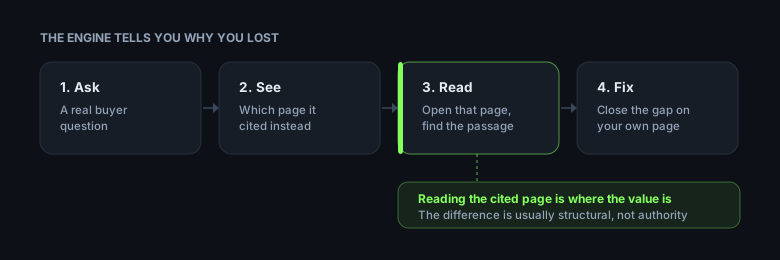
This is the part that is genuinely easy on Perplexity, and worth doing before changing anything.
Write down the ten questions a buyer would ask before choosing your product.
Ask each one, in a fresh session with no prior context.
Record whether you are cited, and which sources were used instead.
Open the pages that were cited and read the exact passage the citation points to.
Compare that passage against the equivalent section on your own page.
Step five is where the value is. You are not guessing at what the engine wants; you are reading the thing it chose. In most cases the difference is not depth or authority. It is that their sentence answered the question and yours built up to it.
Rewriting a claim so it can be cited
The gap between a page that gets cited and one that does not is usually a single sentence. Three examples of the same fact, written three ways.
Uncitable, because the subject is missing
"They usually need replacing every three months." Lifted out of the page, nobody knows what "they" refers to, so the engine passes over it.
Uncitable, because it refuses to commit
"Replacement frequency depends on water hardness, household size, and usage patterns." Entirely true, and there is nothing here to relay to somebody who asked how often.
Citable
"A standard household water filter needs replacing every three months, sooner in hard water areas or with heavy use." Same information, same accuracy, and it stands alone.
The pattern is consistent: name the subject, give the typical case, then qualify. Most writing does the reverse, qualifying first and arriving at the specific last, which is exactly backwards for extraction.
What to do with the pages you already have
This does not require new content. Most stores have more available gain in the pages they published years ago than in anything they might write next.
Start with pages already getting impressions for question-shaped queries, since those are pages search engines already consider relevant. The retrieval half is solved and only the quotable half is missing, which makes them the cheapest wins available.
Work through them one section at a time, moving the answer to the front and making sure each claim names its own subject. This is editing rather than writing, it takes minutes per section, and it frequently produces citations within weeks because the pages are already indexed.
Perplexity compared with other engines
Perplexity
ChatGPT
Google AI Overviews
Sources shown
Always, per claim
Sometimes
Linked, less prominent
Retrieval
Every query
For current questions
Every query
Easy to audit
Yes
Partly
Partly
Favours recency
Strongly
Moderately
Varies by query
Good first target
Yes
Later
Later
Optimise once, verify on Perplexity, and expect the gains to appear elsewhere. Maintaining separate strategies per engine is wasted effort.
Why your competitors get cited instead
When you read the pages Perplexity chose over yours, the reasons cluster into a short list.
They answered the exact question in a heading, where your page covered it inside a broader article.
Their claim was one sentence. Yours was three sentences of nuance that cannot be quoted without losing the point.
They gave a number. You wrote "varies depending on use", which is more accurate and completely unusable.
Their page was updated recently and yours was not.
They are a publisher, not a store. This is the one structural disadvantage, and it is beatable on narrow questions where you know more than a generalist does.
The accuracy problem in the third point is worth sitting with. "It varies" is often the honest answer, and it earns no citation. The fix is to give the typical case first and the variation after: "usually three to six months, less if you brew daily" is both quotable and true.
Structure that helps retrieval
Headings phrased as the question
A heading that reads "How long does a burr grinder last" matches the way people ask far better than "Longevity", and it tells the retrieval step exactly what the section below settles. Descriptive headings are the cheapest structural win available.
Sections that stand alone
Each section should make sense to somebody who arrived at it directly, because that is effectively what happens. A section that leans on three earlier sections for its meaning cannot be used on its own.
FAQ answers that match the page
If you use FAQ schema, the marked-up answer must be the visible answer, word for word. A mismatch is a structured data violation, and the divergence gives the engine two different versions of the same claim.
One clear topic per page
Pages covering four loosely related subjects rarely get cited for any of them, because no single section answers a question completely. Splitting them usually lifts all the resulting pages.
How long this takes to show results
Faster than traditional rankings, because there is no queue to climb. Once a page is indexed and retrievable, it can be cited the next time somebody asks a relevant question. Edits to already-indexed pages often show up within a few weeks.
New pages take longer, since they need to be discovered and indexed first. That is the main argument for starting with pages you already have rather than commissioning new ones.
What Rankmore tracks here
Rankmore checks Perplexity weekly for mentions of your store against the keywords in your campaigns, and records what it finds. That gives you the trend rather than a single sample, which matters because answers vary between sessions.
Coverage of other engines is rolling out. Perplexity came first for the same reason it belongs first in your own testing: it shows its sources, so the data is verifiable rather than inferred.
Common mistakes
Testing once and drawing conclusions. Answers vary. Sample repeatedly.
Testing in a session that already discussed your brand. It will mention you, and that tells you nothing.
Chasing recency by republishing unchanged pages. Changing a date without changing content is transparent and pointless.
Writing for the engine rather than the reader. Sentences engineered for extraction read badly, and readers leaving is a signal in its own right.
Ignoring what the cited pages actually say. The answer is right there and most people never look.
Who this is for
Any store whose buyers research before purchasing, and specialist retailers in particular. Perplexity's audience skews toward people who want sources and comparisons, which is exactly the buyer a specialist is best placed to serve.
It matters less for impulse purchases, where nobody consults an assistant before buying.
Final thoughts
Perplexity is the engine that tells you why you lost, which makes it the cheapest place to learn. Ask your buyers' questions, read the pages it cited instead of yours, and fix the specific difference you find.
In most cases that difference is not authority, budget or backlinks. It is that somebody else wrote a sentence that answered the question, and you wrote a paragraph that approached it.
Frequently asked questions
How does Perplexity choose its sources?
It searches on every query, retrieves candidate pages, and attaches citations to individual claims rather than listing sources at the end. It favours pages where the relevant claim sits in a self-contained sentence that can be quoted cleanly.
Why should I optimise for Perplexity first?
Because it shows its sources on every answer, so you can see exactly which page was cited for which claim and read it. That makes it the only engine where you can verify what worked, and the improvements transfer to ChatGPT and Google AI Overviews.
How do I check whether Perplexity cites my store?
Ask the ten questions your buyers would ask, in fresh sessions with no prior context, and record whether you appear. Then open the pages that were cited instead and read the exact passage, since the difference is usually visible immediately.
Does Perplexity prefer recently updated pages?
For questions where currency matters, yes, more strongly than other engines. A guide untouched for years competes poorly against one revised recently. Changing a date without changing content does not help, since the content itself is what is assessed.
Why do publishers get cited instead of my store?
Publishers write in the format these engines quote: direct answers to specific questions. It is the one structural disadvantage a store has, and it is beatable on narrow questions where a specialist genuinely knows more than a generalist writer does.
Should I write differently for Perplexity than for Google?
No. The same structure helps both: answers near the top of each section, claims that carry their own subject, and specific checkable detail. Perplexity is where you verify the work rather than a separate discipline.
Is being cited by Perplexity worth traffic?
It brings some clicks, since citations are prominent and readers do follow them to verify. The larger value is being named as the source at the moment someone is deciding, which often shows up later as branded search rather than direct referral traffic.
Does Rankmore track Perplexity citations?
Yes, weekly against your campaign keywords, recording what it finds so you get a trend rather than a single sample. That matters because answers vary between sessions, which makes any one check unreliable on its own.