Shopify AI SEO: Getting Your Store Cited in AI Answers
A growing share of buyers ask an assistant before they search. Being the answer is a different job from ranking first, and it is winnable earlier.
What changed about how people find stores
For twenty years the shape of product research was the same: type a query, scan ten blue links, click two or three. That shape is fracturing. A meaningful share of buyers now ask ChatGPT which product to buy, read Google's AI Overview instead of scrolling to the results, or ask Perplexity to compare three options and cite its sources.
The consequence for a store is uncomfortable. In classic search you competed for a position. In AI search you compete to be quoted, and if you are not quoted you are not merely lower down the page, you are absent from the answer entirely.
How AI answers get assembled
The mechanics matter, because they explain what to change.
Retrieval, then synthesis
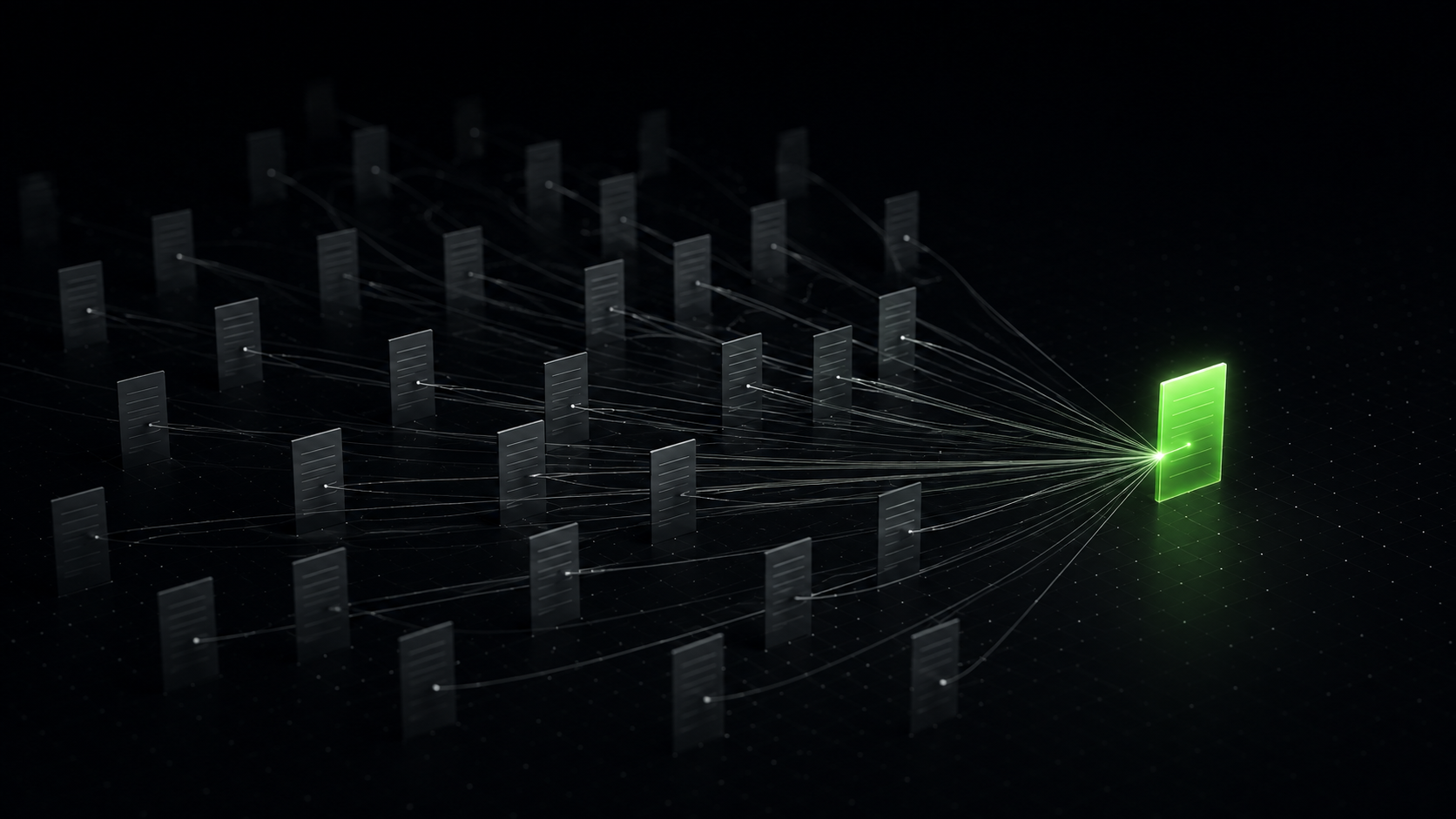
An assistant answering a shopping question does not recall your store from training. It searches, retrieves a handful of pages, and writes an answer from what it found. Your page is competing to be one of those retrieved sources, and then to be the part the model finds worth quoting.
Passages, not pages
The unit that gets cited is usually a passage rather than a whole page. A section that answers one question completely, in a way that stands alone when lifted out of context, is far more citable than the same information spread across four paragraphs of build-up.
Corroboration
Assistants prefer claims they can find in more than one place. A store that is the only source for a claim about its own product gets treated with more caution than one whose claims are echoed in reviews, press and independent coverage.
Why this is winnable earlier than classic SEO
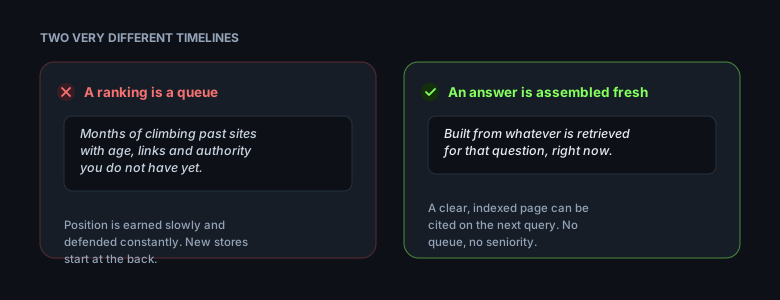
Ranking first on Google for a competitive term takes months and usually requires outranking established sites with years of accumulated authority. Getting cited works differently. An assistant assembling an answer needs sources that address the specific question well, and specific questions are frequently answered badly or not at all by the big sites.
That asymmetry is the opportunity. A store that answers a narrow question better than anyone else can be cited for it without ranking first for anything, because citation rewards precision where ranking rewards authority.
Want this done for you?
Rankmore writes the cluster, links it, and tracks the rankings.
Put the direct answer immediately under the heading that asks it, then explain. The common pattern of context, then background, then eventually the answer, is optimised for a reader who has already committed. An assistant extracting a passage takes what is near the top of the section.
Use headings that match real questions
A heading reading "Sizing" is a label. A heading reading "How do I know which size to order" is a question, and it matches the shape of what someone actually asks an assistant. Question-shaped headings make it obvious which passage answers which query.
Write self-contained sections
Test each section by reading it alone. If it depends on the paragraph above to make sense, it will be quoted badly or skipped. Sections that survive extraction get used.
Add FAQ markup that matches the visible text
FAQ structured data tells a machine exactly which passage answers which question, with no parsing required. It has to match the text a visitor sees, word for word. Schema that disagrees with the page is a manual action risk, and it is one of the few SEO mistakes that can cost you more than it gains.
Be specific where you can be checked
Assistants favour claims that carry detail: materials, measurements, timescales, conditions. Vague superlatives are unquotable because there is nothing in them to relay. "Ships in two business days from a UK warehouse" can be cited. "Fast shipping" cannot.
Put your product facts where they can be found
Product specifics that live only in an image, a PDF spec sheet or a tab that loads on click are effectively invisible to retrieval. Materials, dimensions, compatibility and shipping terms need to exist as text on the page. This is the single most common reason a store with genuinely good product information never gets cited for it.
Keep claims current
An assistant that cites your two-day shipping promise will keep citing it after you change to five, because it is reading a page you have not updated. Anything time-sensitive on a page that earns citations needs a review schedule, or it becomes a source of confidently delivered misinformation about your own business.
Where product pages fit
Product pages rarely get cited directly, which surprises people. An assistant answering "what is the best running shoe for flat feet" is looking for something that compares options and explains criteria, and a page selling one shoe does neither.
What gets cited is the content around the product: the comparison, the guide, the explanation of how to choose. Those pages then link to the product. The pattern mirrors classic SEO, where content ranks for the research question and passes the reader to the page that sells.
This is why stores with no content struggle in AI search regardless of how well their product pages are written. There is nothing on the site shaped like an answer.
Classic SEO compared with answer engine optimisation
Classic search
AI answers
You compete for
A position
A citation
Unit that wins
The page
A passage
Rewards
Authority and links
Precision and structure
Second place gets
Some traffic
Usually nothing
Time to compete
Months to years
Weeks to months
Measurement
Position tracking
Citation tracking
The two overlap more than the table suggests. Nearly everything that earns citations also helps classic rankings, because clear structure and genuine specificity were always what search engines were trying to reward. What has changed is the penalty for padding.
How to measure whether it is working
Position tracking does not answer this question, because a citation is not a position. The honest measurement is to ask the assistants directly and repeatedly: pose the questions your buyers would ask, and record whether your store appears and how it is described.
Do it on a schedule rather than once, because answers vary between sessions and drift as models update. A single check tells you almost nothing, while the same twenty questions asked weekly tells you whether you are becoming part of the answer.
Watch how you are described as well as whether you appear. Being cited with an out of date claim about your shipping or pricing is worse than not being cited, and it is fixable once you know.
How long this takes
Faster than classic ranking, and not instant. Once a page is indexed it becomes eligible for retrieval quickly, so citations can begin within weeks rather than the months competitive rankings demand. What takes longer is consistency: appearing once in one session is noise, and appearing reliably across sessions and engines is the actual goal.
Expect variation that would look like a bug in classic rank tracking. The same question asked twice in one afternoon can produce different sources. Judge it the way you would judge a poll, on the trend across many samples rather than any single answer.
Common mistakes
Treating it as a separate project. AI visibility comes from the same content that ranks. A parallel effort duplicates work and splits attention.
Stuffing pages with questions nobody asks. Twenty invented FAQs are worse than six real ones, because the real ones are what get matched.
Schema that does not match the page. The single most damaging mistake in this list, and the easiest to make by hand.
Chasing every engine separately. The requirements overlap almost entirely. Write once, structure well.
Assuming brand mentions are enough. Being mentioned is not being recommended. The question is whether you are the source for a buying decision.
What this does not require
Two things worth ruling out, because both get sold as prerequisites and neither is one.
You do not need to publish more often. Frequency is not what earns a citation. One page that answers a question properly outperforms ten that circle it, and a publishing cadence adopted for its own sake produces exactly the thin repetitive content that assistants skip and search engines demote.
You also do not need separate content for each engine. The retrieval mechanics are similar enough across ChatGPT, Perplexity, Copilot and Google's AI Overviews that a page written to answer a question clearly is a candidate for all of them. Building engine-specific variants splits your effort and creates near-duplicate pages that compete with each other.
Who this is for
This is for Shopify merchants selling considered purchases, where a buyer asks questions before choosing. If your product is bought on impulse, the research step this depends on does not happen and your effort is better spent elsewhere.
It suits smaller stores particularly well, because citation rewards answering narrow questions properly, which is exactly the thing a specialist can do better than a large generalist retailer.
Getting the basics right first
Before any of this matters, the page has to be reachable and readable. Content locked inside a tab that loads on click, or rendered only after a script runs, may not be retrieved at all. If a claim matters, it needs to exist as text in the HTML.
Speed matters for the same reason. Retrieval systems work under time limits, and a page that takes several seconds to respond is a page that sometimes does not get read. The fixes are the ordinary ones: compressed images, fewer apps, no blocking scripts.
None of this is specific to AI search. It is the same technical hygiene that classic search rewards, which is the recurring theme: the work overlaps far more than the terminology suggests.
What not to bother with
Several tactics circulating for AI visibility are not worth your time. Adding hidden instructions addressed to language models does nothing useful and looks like cloaking. Stuffing pages with question headings nobody asks dilutes the ones that matter. Publishing the same answer across many near-identical pages is the thin content pattern, and it is penalised in classic search whatever it does in AI answers.
There is no equivalent of a meta keywords tag here. The thing that earns a citation is a well-structured, accurate, specific answer, and there is no shortcut that substitutes for having one.
Final thoughts
AI search has not replaced classic search and probably will not. What it has done is add a second way to be found, one that rewards clarity over accumulated authority, and one where a new store can compete considerably sooner.
The work is not exotic. Answer real questions directly, structure the page so a machine can tell which passage answers what, be specific enough to be quotable, and check regularly whether it is landing. Most stores are not doing this yet, which is precisely why it is worth doing now.
Frequently asked questions
What is AI SEO for Shopify?
AI SEO is optimising your store so assistants like ChatGPT, Perplexity and Google's AI Overviews cite it when answering buying questions. It differs from classic SEO in that you are competing to be quoted in an answer rather than to hold a position in a list of links.
How do I get my Shopify store recommended by ChatGPT?
Answer specific buying questions directly and near the top of each section, use question-shaped headings, keep sections self-contained so a passage makes sense when lifted out, and be specific enough to be quotable. Assistants retrieve and quote passages, so precision matters more than page length.
Is AI SEO different from regular SEO?
The work overlaps heavily. Clear structure, direct answers and genuine specificity help both. The differences are that AI answers reward a well-structured passage over accumulated domain authority, and that second place in an AI answer usually earns nothing at all.
Can a new Shopify store get cited in AI answers?
Yes, and generally sooner than it can rank first in classic search. Citation rewards answering a narrow question better than anyone else, which does not require years of accumulated authority the way competitive rankings do.
Does FAQ schema help with AI search?
It helps, because it tells a machine exactly which passage answers which question without needing to parse the page. The critical requirement is that the schema matches the visible text exactly. Mismatched FAQ markup risks a manual action, which costs more than the markup gains.
How do I track whether AI engines mention my store?
Ask the assistants the questions your buyers would ask, on a regular schedule, and record whether you appear and how you are described. Answers vary between sessions, so a single check proves little while the same set of questions asked weekly shows a trend.
Which AI engines should I optimise for?
Optimise once for all of them. ChatGPT, Perplexity, Google AI Overviews and Copilot assemble answers in broadly the same way, from retrieved sources, so the structural work that earns a citation in one tends to earn it in the others.
Does AI search reduce traffic to my store?
It can, when an assistant answers a question fully and the reader never clicks. That makes being the cited source more valuable, not less, because the citation is what carries your brand into the answer even when no click follows.