AI Visibility: Measuring Whether AI Search Knows Your Store
There is no rank to check in AI search. Here is how to find out whether assistants know your store, and how to track it over time.
The measurement problem
Traditional SEO has a number. You are third for a keyword, or you are not, and a tool tells you which. AI search has no equivalent. There is no position, no dashboard, and the same question asked twice can return different sources.
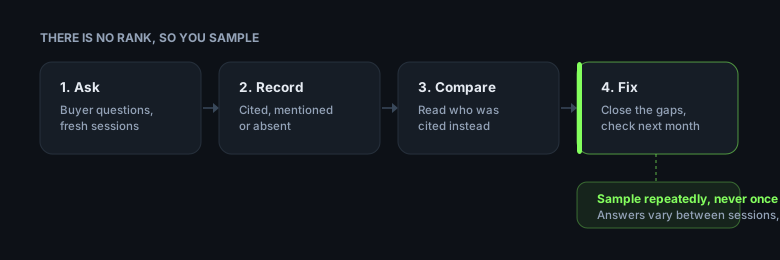
That is why most stores have no idea whether assistants mention them. Not because they are careless, but because the obvious way to find out does not exist. What replaces it is sampling: ask the questions your buyers ask, repeatedly, and record what comes back.
It sounds crude. It is also the only honest method, and once you have a few weeks of it, the picture is clearer than a rank tracker ever gave you, because you are measuring what was actually said about you rather than where a link sat.
What AI visibility actually means
Being cited
Your page is used as a source and linked. This is the strongest outcome and the easiest to verify, since engines like Perplexity show their citations openly.
Being mentioned
Your brand is named in the answer without a link. Weaker on paper, but frequently more valuable, because a recommendation inside an answer carries more weight than a link beside it.
Being described accurately
The engine knows what you sell, who you serve, and what makes you different. Many stores are known but described wrongly, which is a distinct problem with a distinct fix.
Being absent
The engine answers the question using competitors, publishers or marketplaces and never reaches you. This is the default state for most stores, and it is a content problem rather than a technical one.
Building a question set
Everything downstream depends on asking the right questions, so this is worth doing carefully rather than quickly.
Start with your buyers. What do they ask before purchasing? Support tickets and pre-sale emails are the best source, because they are real language rather than keyword-tool language.
Include category questions. "What is the best X for Y" and "which X should I buy for Z". These decide purchases.
Include problem questions. People often describe a symptom rather than a product. "Why does my X keep doing Y" reaches buyers earlier than any product query.
Include comparison questions. "X vs Y" and "is X worth it". High intent, and assistants answer them readily.
Include your brand. "Is Brand legitimate", "what does Brand sell", "Brand returns policy". You need to know what is being said.
Twenty to thirty questions is enough. Fewer and the sample is noise. More and you will stop running it, which is worse than a smaller set run consistently.
Want this done for you?
Rankmore writes the cluster, links it, and tracks the rankings.
An assistant that already discussed your brand will mention it again. Every check must start clean or the result is worthless.
Ask the question as a buyer would
Not "best organic coffee beans UK site:mystore.com" but the sentence a person would type. Keyword syntax produces answers no real user will ever see.
Record more than yes or no
Note whether you were cited, mentioned or absent, which competitors appeared, and which sources were used. The competitor column is where the useful information is.
Sample repeatedly
Answers vary between sessions. One check tells you almost nothing; five spread over a fortnight tells you whether you are genuinely in the mix or got lucky once.
Keep the record
A spreadsheet is fine. The value is in the trend, and you cannot see a trend from memory.
Reading the results
What you see
What it means
What to do
Never appear anywhere
No content answering these questions
Write the answers, plainly
Appear on brand queries only
Known, but not as a category source
Build topic depth beyond your products
Appear occasionally
In the pool, not the first choice
Tighten the passages that nearly won
Described inaccurately
Stale or third-party sources dominate
Publish the correct facts on your own site
Competitors always cited
They answered, you approached
Read their page, copy the structure not the words
The last row is the most common and the most fixable. Open the page that was cited, find the exact passage, and compare it with the equivalent section on yours. The difference is usually structural rather than a matter of authority.
What moves the number
Answering questions directly
The single largest factor. A section that opens with the answer beats one that builds toward it, every time, on every engine.
Specific and checkable claims
Numbers, materials, timeframes, conditions. Assistants relay concrete detail and skip over generalities, because generalities are not worth relaying.
Topic depth rather than product pages
Stores that only publish product pages are invisible for informational questions, which is most of them. Depth on the subject is what gets you into the pool.
Consistency across your site
If three pages give three different answers to the same question, none of them is trusted. Contradictions are more damaging here than thin content.
Being mentioned elsewhere
Assistants draw on the whole web, not just your site. Reviews, forums, supplier pages and press all feed the picture. You cannot control these, but you can be worth mentioning.
Fixing an inaccurate description
This deserves separate treatment because the instinct is usually wrong. When an assistant describes your store incorrectly, the cause is almost never malice or a bug. It is that the correct information is not stated plainly anywhere it can find.
Say you stopped selling a category two years ago and assistants still list it. Somewhere there is an old page, a directory listing or a review that says otherwise, and nothing on your site contradicts it clearly. The fix is a page that states what you sell now, in plain sentences, on your own domain.
The same applies to shipping, returns, and whether you are a real business. If your policies live only inside a checkout flow, no engine can read them. Put them on a page, write them as sentences rather than bullets of legal text, and the description improves within weeks.
How often to check
Monthly is enough for most stores, with a fuller review each quarter. Weekly checking produces noise that looks like movement and encourages changes that were never justified.
The exception is after publishing significant content or correcting a factual error, where a check two to three weeks later tells you whether the change was picked up.
What Rankmore does here
Rankmore checks Perplexity weekly against your campaign keywords and records whether your store appears, so you get a trend without running the sampling by hand. Coverage of other engines is rolling out.
That does not replace your own question set, and it is not meant to. Automated checks track the keywords you are actively working on; your manual set covers the awkward, specific, human questions that never look like keywords and are often where the buying decisions happen.
Turning a check into a work list
Sampling only pays off if the results become tasks. After each monthly round, the record should produce three short lists.
Questions you lost narrowly
You appeared sometimes, or a competitor was cited from a page barely better than yours. These are the cheapest wins, because the page already exists and already ranks well enough to be considered. Tighten the passage and re-check next month.
Questions you have no page for
You were absent every time and nothing on your site addresses the question. These need writing, and they should be prioritised by how close the question sits to a purchase rather than by how often it is asked.
Facts that came back wrong
Anything the engine stated about your business that is not true. Treat these as urgent regardless of volume, because a wrong answer about shipping or legitimacy costs more than a missing answer ever does.
Three lists, worked through in that order, is the whole programme. It is unglamorous and it compounds, which is a fair description of most things that work in search.
What good looks like after six months
Realistic expectations help here, because the early weeks look like nothing is happening.
By month two you should see occasional appearances on the narrow questions where you genuinely know more than a generalist publisher does. By month four, appearances on those become common rather than occasional, and brand descriptions read correctly. By month six, you should be appearing on at least some category questions, which are the hardest and the most valuable.
What you should not expect is to displace large publishers on broad questions like "best coffee grinder". That is a fight worth losing gracefully. The specific questions underneath it, where you have real handling experience, are both winnable and closer to a sale.
Common mistakes
Checking once and concluding. Variance between sessions is large. Sample repeatedly or do not bother.
Testing in a polluted session. If your brand came up earlier in the conversation, the result is meaningless.
Only tracking your own name. Brand queries are the easy ones. Category questions are where new customers are.
Ignoring who won instead. The cited competitor is the most useful output of the whole exercise and most people never open it.
Expecting a single score. There is no rank here. Direction over months is the honest measure.
Final thoughts
AI visibility is measurable, just not the way rankings were. Ask real buyer questions in clean sessions, record what comes back including who won instead, and repeat monthly.
Most stores that do this discover the same two things: they are absent from every category question, and the pages beating them are not better resourced, just better structured. Both are fixable with editing rather than budget.
Frequently asked questions
How do I check if AI search knows my store?
Ask the questions your buyers ask, in fresh sessions with no prior context, and record whether you are cited, mentioned or absent. Repeat each question several times over a fortnight, since answers vary between sessions and one check proves nothing.
Is there a rank tracker for AI search?
No, because there is no position to track. The honest method is repeated sampling of a fixed question set, which gives you a direction over months rather than a number. Rankmore automates part of this by checking Perplexity weekly.
Why does AI search describe my store incorrectly?
Almost always because the correct information is not stated plainly on your own site, so the engine relies on old pages, directories or reviews. Publishing the current facts as clear sentences on your own domain usually corrects it within weeks.
How many questions should I test?
Twenty to thirty covering category, problem, comparison and brand questions. Fewer produces noise, and more tends to mean you stop running it, which is worse than a smaller set checked consistently every month.
How often should I check AI visibility?
Monthly for most stores, with a fuller review quarterly. Weekly checks produce variance that looks like movement and prompt changes that were never justified. Check sooner only after publishing major content or fixing a factual error.
Why do competitors get cited instead of my store?
Usually because they answered the question directly and your page approached it gradually. Open the page that was cited, find the exact passage used, and compare it with your equivalent section. The difference is normally structural, not authority.
Do product pages help AI visibility?
Rarely, because most assistant questions are informational rather than transactional. Stores publishing only product pages stay invisible for the questions buyers ask before choosing. Topic depth is what gets you into the pool of considered sources.
Does being mentioned without a link matter?
Yes, often more than a citation. A brand named inside an answer carries the weight of a recommendation, and it commonly shows up later as someone searching your name directly rather than as immediate referral traffic.