Shopify SEO Automation: What Can Be Automated and What Cannot
Some of SEO is repetitive work a machine should be doing. Some of it only looks that way. Getting the line right is what separates useful automation from a store full of content nobody should have published.
Why automation is tempting here specifically
Shopify SEO has an unusual shape. A store with 400 products has 400 title tags, 400 meta descriptions, several thousand images needing alt text, and a catalogue that changes every week. The work is not intellectually difficult. It is simply enormous, repetitive, and never finished.
That profile is exactly what automation is for. The difficulty is that the same word covers two very different things: automating work that is genuinely mechanical, and automating work that only looks mechanical from a distance.
What genuinely automates
Structural and technical work
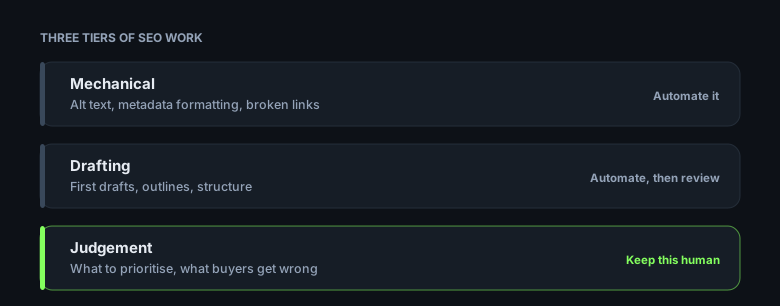
Sitemaps, canonical tags, schema markup, redirect creation when a handle changes, detecting broken links, flagging pages missing a description. These are rule-based. A machine applies the rule more reliably than a person does, and never gets bored on product 300.
Bulk field population
Generating a title tag from a pattern across a catalogue is real automation with real value. So is producing alt text describing what is in a product photo. The output is short, the format is predictable, and the failure mode is mild.
Measurement
Checking positions daily, capturing which pages rank for what, watching for drops. No person should be doing this by hand, and a machine does it more consistently than a spreadsheet ever will.
What only looks automatable
Deciding what to write about
Keyword tools produce lists. Choosing which terms are worth your effort requires knowing your margins, what you actually stock, which customers are worth attracting and which are not. A tool suggesting a high volume term has no idea whether the visitors it brings can buy anything from you.
Judging whether copy is good
A machine can produce a page that satisfies every checklist and still reads as though nobody meant it. Scores cannot detect this, because the checklist is what the page was written against. Only a person who knows the brand can tell.
Knowing what is true about your business
Shipping times, materials, guarantees, what your product does not do well. Automation writes plausible claims, and plausible is not the same as accurate. Confidently published misinformation about your own store is worse than an empty page.
The trap of tag-only automation
Most apps sold as SEO automation automate the first list and stop. That is genuinely useful, and it has a hard ceiling that is rarely stated.
Perfect meta tags improve how your existing pages present themselves in results you already appear in. They do not create appearances for terms you do not cover. If your store has no page addressing what buyers research before purchase, no amount of tag optimisation produces one, and a store can spend a year perfecting tags while remaining invisible for every question that matters.
This is the ceiling worth understanding before buying anything: tag automation improves the pages you have. Content is what gives you pages to improve.
Want this done for you?
Rankmore writes the cluster, links it, and tracks the rankings.
The strongest case is not any single task. It is the sequence.
A content cluster involves keyword research, writing a main guide, writing supporting articles, placing internal links between them in both directions, publishing on a schedule, and tracking what happens. Each step is manageable alone. Together they are a month of work per topic, which is why most stores start one and abandon it.
Automating the sequence while keeping approval on the output is the arrangement that survives contact with reality: the machine does the assembly and the persistence, and you keep the judgement about whether anything is good enough to carry your name.
How to evaluate an automation tool before committing
Demos show the dashboard, which is the part every vendor has polished. Four questions get past that.
What does it hand back?
A report, or a published page. Both are legitimate products, priced as though they are the same thing. Know which you are buying.
Can you see real output before paying?
Ask for a sample of what the paid tier actually produces for a store like yours, not a feature list. If a vendor cannot show you a live page it generated, that is an answer.
What happens when it is wrong?
Every automated system produces bad output sometimes. The question is whether that output reaches your storefront before you see it, and whether the tool records what it changed so you can reverse it.
What survives uninstall?
App code, metafields and injected scripts routinely outlive the app. Leftovers from tools tried and abandoned are a common reason a store is unexplainably slow.
What automated content gets wrong
Read anything automated with these in mind, because they are the recurring failures.
Restating the heading. A section titled "Benefits of X" opening with "There are many benefits to X" has spent a sentence saying nothing.
Hedging everything. Copy that never commits reads as though the writer has no experience, because usually it has none.
Announcing structure. "In this section we will explore" is a machine narrating its own outline.
Vocabulary nobody says aloud. Certain words cluster in generated text and readers now recognise them instantly.
Invented specifics. The most dangerous failure, because a made-up statistic reads more convincingly than a real one.
A useful test: would you send this to a customer who asked the question? If it needs editing first, it is not ready for your domain either.
Keeping approval in the loop
Any automation writing to your live storefront should show you the work first. This is not caution for its own sake. Published pages are indexed, cited by assistants, and attached to your brand indefinitely, and unpublishing does not undo the impression.
Approval also solves the accuracy problem cheaply. You do not need to verify a machine's general knowledge, only the handful of claims it makes about your business, and those are visible in the draft.
Treat auto-publishing as a warning sign in any tool you evaluate. The convenience is small and the exposure is permanent.
What automation actually costs
Worth understanding because it explains pricing across the category. Automation that only edits fields costs its developer almost nothing to run, which is why those apps are cheap or free.
Automation that researches keywords, checks positions daily and generates content is paying per keyword lookup, per rank check and per article to outside providers. Those costs recur whether or not you log in. An app doing daily tracking across a hundred keywords is spending money on your behalf every day, and that is the honest reason genuinely unlimited plans do not exist.
What to do with output you are not happy with
The instinct is to rewrite it, which wastes most of the benefit. A better sequence is to work out which input produced the problem.
Generic copy usually means the tool was given nothing specific to work with. Most content automation accepts brand context, an author, an origin story, differentiators, and customer language. Left empty, it falls back on generic defaults, and the output reads exactly as generically as the input deserved.
Factually wrong copy means a claim was invented rather than supplied. The fix is to provide the fact rather than to correct each instance, because the same invention will recur on the next article.
Copy that is accurate but flat is usually a voice problem, and the same fix applies: give the tool real sentences from your own writing to work from rather than an adjective describing the tone you want.
Common mistakes
Automating volume before quality. Twenty thin pages published quickly is the pattern search engines demote. Three good ones is not.
Trusting a score instead of reading. The score measures compliance with the checklist the page was generated against.
Running several automation apps together. They overwrite each other's tags and schema, leaving contradictory signals on the same page.
Assuming automation replaces strategy. A tool executes a plan. It does not decide which products are worth ranking.
Never re-reading what was published. Automated claims about shipping and pricing go stale, and stale claims get cited.
Who this is for
Automation makes sense if you have more catalogue than time, if the work has been on your list for months without moving, or if you have accepted that content is necessary but cannot personally write forty articles.
It makes less sense if you have very few products and enjoy writing, since at that scale doing it yourself is faster than evaluating tools, and the output will be better.
Final thoughts
The line worth holding is straightforward. Automate the work that is repetitive and where mistakes are cheap. Keep judgement on the work that carries claims about your business or your name.
Most SEO automation stops short of the part that actually takes a month, and most of the risk sits in the part that publishes without asking. A tool that does the long assembly while showing you the output before it goes live is on the right side of both lines.
Frequently asked questions
What parts of Shopify SEO can be automated?
Sitemaps, canonical tags, schema markup, redirects, broken link detection, bulk meta tags, image alt text and rank tracking all automate reliably because they are rule-based or repetitive. Choosing which keywords are worth targeting and verifying claims about your business should stay with you.
Is automated SEO content bad for rankings?
Not inherently. Thin, repetitive content published at volume is what gets demoted, and that describes badly automated content specifically. Automated drafts that a person reviews and approves before publishing are treated the same as anything else.
Will Google penalise AI-written content?
Google's stated position targets content produced primarily to manipulate rankings rather than the tool used to write it. The practical risk is publishing at volume without review, since that reliably produces thin repetitive pages, which is the pattern the helpful content systems demote.
Should SEO automation publish to my store automatically?
Only with your approval. Published pages are indexed, cited by AI assistants and attached to your brand indefinitely, and unpublishing does not undo that. Review also lets you catch invented claims about your shipping, materials or pricing, which is the most damaging failure mode.
Can automation replace an SEO agency?
It replaces the execution, not the strategy. Automation handles the repetitive production and persistence that agencies charge for. Deciding which products deserve investment and whether output is good enough to publish still needs someone who knows the business.
Why do SEO automation apps have usage limits?
Because each keyword lookup, rank check and generated article costs the developer money in outside API calls, recurring daily whether or not you log in. Genuinely unlimited generation would mean unlimited cost, so unlimited plans carry fair-use caps.
How much time does SEO automation actually save?
The largest saving is on the sequence rather than any single task. A content cluster takes roughly a month by hand across research, writing, linking and scheduling. Automating that assembly while reviewing the output turns a month into a few hours of reading.
Can I run more than one SEO automation app?
It is not advisable. Multiple apps overwrite each other's meta tags and schema, leaving contradictory signals on the same page, and each adds script weight that slows the storefront. Slower pages hurt rankings, so stacking tools can be self-defeating.