Shopify Product SEO: How to Make Product Pages Rank
Product pages can be optimised properly and still never rank for the terms that bring buyers. Here is how to do the optimisation well, and where the real limit sits.
What a product page can and cannot rank for
Start with the limit, because it determines how much effort is worth spending. A product page can realistically rank for the product itself, close variations of it, and the brand. It will not rank for the questions people ask before they know your product exists.
A page selling merino hiking socks can rank for "merino hiking socks" and "blister free wool socks". It will not rank for "how to stop blisters on long hikes", because that searcher wants advice and Google knows a product page is not advice.
This matters because the second query has far more traffic than the first. Optimising product pages is worth doing properly, and it is not a traffic strategy on its own. What it does is convert the traffic that arrives already knowing what it wants.
The product title
Your product title does more work than any other field. It becomes the H1, it usually seeds the page title, and it is what a shopper scans in search results.
A shape that works
Lead with what the thing is in the words a buyer would use, add the qualifier that distinguishes it, and put the brand last if at all. "Merino Wool Hiking Socks, Blister Free" describes something. "Alpine 3.0" describes nothing to anyone who has not already heard of it.
Internal names cost you traffic
Stores frequently title products with their internal SKU vocabulary, which is fine on a purchase order and invisible in search. If nobody outside your warehouse would type it, it should not lead the title.
Meta title and description
Shopify defaults the meta title to your product title, which is adequate and rarely optimal. The meta title has around 60 characters before Google truncates, so the useful move is to add the qualifier that would not fit in the product name itself.
Meta descriptions do not affect rankings directly, and they affect whether anyone clicks a position you already hold. Keep them under 155 characters and give a reason to choose you: what it is, who it suits, and one concrete differentiator. Left empty, Shopify generates one from your body copy, and that auto-generated text routinely runs past 300 characters and reads badly.
The description itself
Most Shopify product descriptions are two sentences and a bullet list, which gives a search engine almost nothing to understand the page by, and gives a buyer almost no reason to trust it.
What to include
What it is and who it is for, in the first two sentences
What it is not suitable for, which builds more trust than any superlative
The question your support inbox receives about this product every week
Three hundred words of specific writing outperforms a thousand words of adjectives. Detail is what search engines index and what buyers are looking for.
Want this done for you?
Rankmore writes the cluster, links it, and tracks the rankings.
Alt text carries more weight on a store than most people expect. It is how image search finds products, it is what a screen reader announces, and it is one of the few places to describe a product plainly without cluttering the page.
Describe what is visible rather than stuffing keywords. "Grey merino wool crew socks folded on a wooden surface" is useful to a blind visitor and to Google. "socks socks wool socks buy socks" helps nobody and looks like manipulation.
File names matter slightly too. A photo named for the product beats one named IMG_4471.
Structured data
Shopify themes usually emit Product schema, which is what puts price and availability into search results. Two things are worth checking.
First, that it is present at all, since some heavily customised themes lose it. Second, that installing several SEO apps has not produced two competing blocks of Product schema on the same page, which is a common and confusing failure.
Review markup should only be present if you genuinely collect reviews. Fabricated review schema is among the fastest ways to earn a manual action.
Which products deserve the effort
Optimising every product to the same standard is how stores exhaust themselves and improve nothing. Catalogues are not uniform, and neither should the effort be.
Start with three groups
Products already getting impressions but sitting below the first page are the fastest wins, because the page is understood and simply not preferred yet. Products with genuine margin deserve effort regardless of current position. Products that define what your store is known for deserve it because they carry the brand.
What to do with the rest
Everything else gets bulk treatment: a decent title pattern, alt text, no empty meta descriptions. That is enough to avoid actively losing, and it costs an afternoon rather than a quarter.
This is also where the honest case for automation sits. Bulk work across a long tail is exactly what machines do better than people, while the handful of products that carry the business deserve writing by someone who knows it.
Variants, collections and duplicate pages
A recurring structural mistake is publishing colours or sizes as separate products. Five near-identical pages compete with each other for the same term, split whatever links they earn, and none wins. Use variants so one page holds the authority.
Collection pages create a related problem. Filters generate URLs that are near-duplicates of each other, and left unmanaged they dilute a collection's signal across dozens of addresses. Shopify handles the common cases with canonical tags, and heavily customised themes sometimes do not.
What breaks product SEO quietly
Problem
Symptom
Fix
Handle changed, no redirect
Old URL 404s, rankings vanish
Create a 301 before changing
Variants as separate products
Near duplicate pages compete
Use variants, one page
Out of stock products removed
Ranked URLs disappear
Keep the page, mark unavailable
Description in an app tab
Text not in the HTML
Keep copy in the page body
Duplicate supplier copy
Nothing to distinguish you
Rewrite in your own words
The first is the most damaging and the most common. Changing a handle without a redirect discards whatever that URL had earned, and also breaks every link pointing at it from your own content.
Supplier descriptions and why they cost you
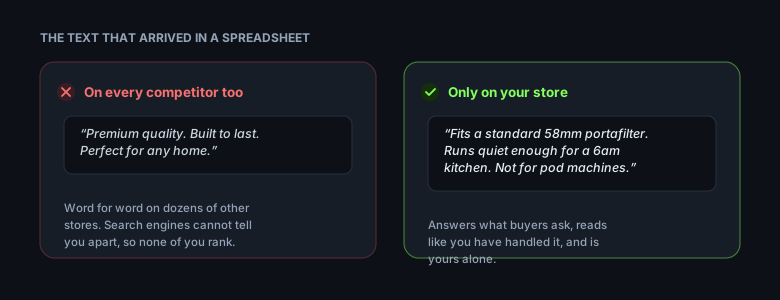
Dropshipped and wholesale products usually arrive with manufacturer copy, and that identical text sits on dozens of stores. Search engines pick one page to show and it is generally the biggest retailer.
Rewriting matters less for the keywords than for having anything of your own. Your handling, your sizing advice, your comparison against the alternative you also stock. That is what is not duplicated anywhere.
Where content fits around product pages
Since product pages cannot rank for research questions, something else must. That is the role of content: an article ranks for the question, answers it properly, and links to the product page for the reader ready to buy.
The linking direction matters. Articles should link to products using the phrase the product page targets, which passes both a reader and a ranking signal to the page you want to rank.
How to tell whether it worked
Product SEO produces a smaller, slower signal than content does, so it needs measuring differently.
Impressions are the first thing to move. A product page whose description went from two lines to three hundred words starts appearing for more variations of its own term, often within a couple of weeks, well before any position changes. That is the sign the page is now understood.
Click-through rate is where meta title and description work shows up. Same position, more clicks, means the snippet is doing its job. If impressions rise and clicks do not, the page is being shown and passed over, which is a snippet problem rather than a ranking one.
Position moves last and moves least, because product terms are usually low volume and reasonably stable. A product that goes from position 14 to 7 on its own name is a real result even though the traffic change may look modest.
Common mistakes
Optimising every product equally. Most catalogues have a handful of products worth real effort. Spread thinly, nothing improves.
Keyword stuffing the description. Repeating the product name eight times reads badly and stopped working long ago.
Deleting discontinued products. A ranked URL is an asset. Keep it, explain, link to the replacement.
Expecting product pages to bring research traffic. They cannot, structurally.
Ignoring the support inbox. The questions customers actually ask are the best description material available and cost nothing to gather.
Who this is for
This suits stores with a focused catalogue where individual products matter, and stores selling considered purchases where buyers read before choosing. If you carry thousands of low-value items, bulk work on titles and alt text is the sensible investment rather than per-product writing.
Final thoughts
Product SEO is worth doing carefully and it is not where growth comes from. Write titles in customer language, descriptions with checkable detail, alt text that describes reality, and protect the URLs you have earned.
Then accept the ceiling and build content around the catalogue, because that is what reaches buyers before they know your product exists.
Frequently asked questions
How do I optimise Shopify product pages for SEO?
Write the title in the words buyers use rather than internal names, set a meta title under 60 characters and a description under 155, write at least 300 words of specific detail covering materials and sizing, add descriptive alt text to images, and confirm Product schema is present and not duplicated.
Why do my Shopify product pages not rank?
Usually because they are competing for terms the page cannot win, or because the description is too thin to establish what the page is about. Product pages rank for the product and close variations, not for the research questions buyers ask before knowing your product exists.
How long should a Shopify product description be?
Around 300 words of specific content outperforms both a two-line description and a thousand words of adjectives. Length matters less than whether it contains checkable detail: materials, dimensions, use, care, and what the product is not suitable for.
Does changing a product URL hurt SEO?
Yes, without a redirect. Changing a handle discards the ranking and link equity that URL earned, and breaks internal links pointing at it. Create the 301 redirect at the same time you change the handle.
Should I delete out of stock products?
No. A ranked URL is an asset, and deleting it discards that plus any links pointing at it. Keep the page, mark it unavailable, and link to a replacement so visitors and search engines both have somewhere to go.
Can I use the manufacturer's product description?
You can, and it puts identical text on dozens of stores, so search engines generally show the largest retailer instead. Adding your own sizing advice, handling detail and comparisons gives the page something that exists nowhere else.
How important is alt text for Shopify SEO?
More than most stores assume. It is how image search finds products and what screen readers announce. Describe what is actually visible in the photo rather than repeating keywords, since stuffed alt text helps nobody and reads as manipulation.
Do product pages need blog content to rank?
Product pages do not need content to rank for their own product terms, but they do need it to reach buyers researching before purchase. Articles rank for those questions and link to the product page, which is the only realistic route to that traffic.