Shopify Blog SEO: Why Store Blogs Fail and How to Fix Them
Nearly every Shopify store starts a blog and nearly every one abandons it. The reason is structural, not effort, and it is fixable.
The pattern almost every store follows
A store launches. Someone advises starting a blog. Nine posts appear over eight months on loosely related subjects: a company update, a seasonal gift guide, a piece about sustainability, something tied to a holiday. Nothing ranks. The blog is quietly abandoned, and the store concludes that content does not work for ecommerce.
The content was rarely the problem. Nine articles on nine unrelated subjects give a search engine nine weak, disconnected signals. The same nine articles on one subject, linked together and pointing at one page you want to rank, give a single strong one.
Effort was never the missing ingredient. Structure was.
What Shopify blogs are usually used for, and why it fails
Company news
Nobody searches for your company news except people who already know you, and those people are already customers. It has a place, and it is not a traffic strategy.
Seasonal gift guides
These can work, and they are brutally competitive against publishers with far more authority, and they expire. A guide written for one December is dead weight by February.
Product announcements
These belong on the product or collection page. As blog posts they compete with your own product pages for the same term, which helps neither.
General industry commentary
Broad opinion pieces attract readers who will never buy anything. Traffic that cannot convert is a vanity number that costs real time to produce.
What a store blog is actually for
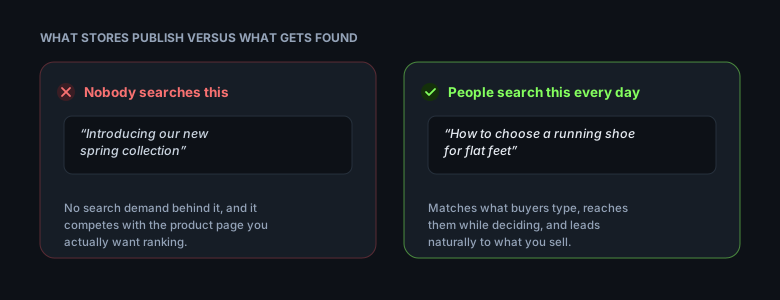
One job: ranking for the questions buyers ask before they know your product exists.
Your product pages rank for your product. Your collections rank for the category. Neither can rank for "how do I stop blisters on long hikes", because that searcher wants advice and a search engine knows a product page is not advice. An article can rank for it, and can then send that reader to the sock collection.
Every post should be traceable to a page it supports. If you cannot name that page, the post is unlikely to earn its keep.
Want this done for you?
Rankmore writes the cluster, links it, and tracks the rankings.
Instead of nine unrelated posts, publish one substantial guide on a subject that matters to your catalogue, then several supporting articles each taking one narrower question, all linking to each other and to the money page.
Scattered posts
A cluster
Signal to search engines
Nine weak, unrelated
One strong, focused
Internal links
Few or none
Every article connected
Supports a money page
Rarely
Always
Compounds over time
No
Yes
Typical outcome
Abandoned
Ranks in months
The mechanism is topical authority. You are not trying to write one post good enough to outrank an established site. You are covering a subject more completely than they have, so the whole set lifts the page you actually want to rank.
Choosing what to write about
Start from the money page
Pick the product or collection you want to rank first. Every article exists to support it. Writing without a destination is how blogs drift into company news.
Mine the questions you already receive
Your support inbox and product reviews contain the exact phrasing customers use. That language is more valuable than any keyword tool because it is real, and it is already sitting there unused.
Match the format that already ranks
Search the term you are targeting. If the results are comparisons, write a comparison. If they are step-by-step guides, write one. The results show what the search engine has decided the query deserves, and arguing with that is expensive.
A worked example
Take a store selling hiking socks, wanting the socks collection to rank.
The guide
One substantial article on choosing hiking socks: materials, thickness, sizing, when each type suits which conditions. Two thousand words or so. It links to the collection using the phrase the collection targets.
The supporting articles
Each takes one narrower question the guide could only touch: how to stop blisters on long hikes, merino compared with synthetic, how to wash wool socks without shrinking them, what thickness suits winter walking, how many pairs to carry on a multi-day route.
Each links up to the guide and across to the collection. The guide links down to each of them.
Why this set and not another
Every one of those questions is asked by somebody who might buy socks, and answered by a page that can honestly recommend yours. Compare that to a post about the history of wool, which is interesting, ranks for nothing commercial, and supports no page.
The test for any planned article is simple: who searches this, and what do they buy afterwards. If the second answer is nothing, it belongs somewhere other than a store blog.
Shopify blog specifics worth knowing
A few platform details affect how this works in practice.
URLs sit under /blogs/<blog>/<article>. You cannot flatten that, so structure lives in your internal links rather than the URL path.
You can run multiple blogs. Most stores do not need to, and splitting a cluster across two blogs makes the linking harder without benefit.
Excerpts control what appears in listings and are worth writing rather than letting Shopify truncate mid-sentence.
Article meta fields exist and are easy to miss, sitting below the editor like the collection description field.
Tags are navigational, not a ranking device. Heavy tagging generates thin archive pages that add nothing.
Where the article should send people
An article that ranks and sends nobody anywhere has done half a job. The link out matters as much as the content.
Link to the collection rather than a single product wherever the reader still has a choice to make. Somebody reading about blister prevention is not yet choosing between your three sock models, and dropping them onto one product page asks them to decide something they have not thought about. The collection lets them compare, which is where they actually are.
Place the link where the reader is convinced rather than at the end. If the article explains that merino resists odour on multi-day walks, the sentence after that is when a reader wants to see merino socks, not four hundred words later in a closing paragraph nobody reaches.
Publishing pace
Consistency beats volume, and both beat bursts. A cluster published over six to eight weeks looks like a store building out a subject. The same articles published in one afternoon looks like exactly what it is, and the systems that demote sites are specifically built to notice.
Pace also protects quality. Writing eight articles in two days produces eight similar articles, because there is no time between them to notice the repetition.
How long before anything happens
Four to eight weeks for a first article to find low competition terms. Three to six months for a cluster to move a competitive page. New domains take longer, and there is no way to shorten it with effort.
Judge early progress on impressions rather than position. A published article that gets indexed and starts appearing for anything is working; one that has been live for three months with no impressions has a problem that more articles will not solve.
What to do with a blog that already failed
Most stores reading this already have the nine abandoned posts. They are not worthless and they should not be deleted.
Sort them into two piles. Anything touching a subject you plan to build a cluster around gets kept, updated, and linked into it. An existing indexed page carries value a new page has to earn from scratch, so absorbing it is faster than replacing it.
Anything genuinely off-topic, the company updates and the holiday posts, can simply be left alone. They do no harm sitting there unlinked, and removing them risks losing a page that was quietly ranking for something nobody checked.
What matters is that the next thing you publish is part of a structure rather than the tenth unconnected post. The failed blog is not a reason to stop; it is the reason the structure matters.
Common mistakes
Publishing without a destination. Every post should support a specific page.
No internal links. An article nothing links to and which links nowhere is invisible to the rest of the site.
Chasing volume over relevance. A high traffic term that brings people who cannot buy from you is worth less than a small one that brings buyers.
Stopping at week six. The timescale is months. Stopping early guarantees the loss and wastes what was already spent.
Deleting old posts. Link them into a cluster instead where they fit; deleting rarely helps and sometimes removes a page that was quietly ranking.
Writing for the algorithm. Copy assembled to hit keyword counts reads as assembled, and readers leave, which the algorithm notices.
Who this is for
This suits stores selling considered purchases, where buyers research before choosing, and stores willing to publish consistently for a few months before judging results. Content SEO rewards persistence more than cleverness.
It suits impulse purchases and pure-marketplace sellers far less. If nobody researches before buying your product, the research step this depends on does not exist.
Final thoughts
Store blogs do not fail because ecommerce content does not work. They fail because nine unconnected posts were never going to work, and that was knowable in advance.
Pick one product worth ranking. Write the guide. Write the supporting articles. Link them to each other and to the product. Publish over weeks rather than days, and measure after a quarter rather than a fortnight. That sequence works, and almost nothing else does.
Frequently asked questions
Do Shopify blogs help SEO?
They help when structured as a cluster supporting a specific product or collection page. Unconnected posts on unrelated subjects rarely rank, which is why most store blogs are abandoned after a handful of articles.
How often should a Shopify store publish blog posts?
Consistency matters more than frequency. A cluster published over six to eight weeks works better than the same articles published in one burst, which looks like bulk publishing and is the pattern search engines demote.
What should a Shopify store blog write about?
The questions buyers ask before they know your product exists. Your product and collection pages already cover product and category terms, so the blog's job is the research stage, and every article should support a specific page you want to rank.
How many blog posts does a Shopify store need?
Structure matters more than count. Nine unrelated posts usually achieve nothing while the same nine focused on one subject and linked together can move a competitive page. A cluster of one guide plus five to eight supporting articles is a realistic starting point.
Why is my Shopify blog not getting traffic?
Most commonly the posts cover unrelated subjects, have no internal links, and support no particular page. Each of those alone limits results and together they guarantee none. Check also that articles are indexed at all, since a page with no impressions after months has a technical rather than competitive problem.
Should I delete old blog posts that are not ranking?
Usually not. Link them into a relevant cluster where they fit, since an existing indexed page has value that a new one has to earn. Deleting occasionally removes a page that was quietly ranking for something you never checked.
Do blog tags help Shopify SEO?
Tags are navigational rather than a ranking device. Heavy tagging generates thin archive pages with little content, which adds crawlable pages without adding value. Use them sparingly for on-site browsing.
How long until a Shopify blog brings traffic?
Four to eight weeks for low competition terms and three to six months for competitive ones, with new domains taking longer. Watch impressions rather than position early on, since impressions move first and show whether pages are understood.